

Desert Rose Guide, Uncategorized
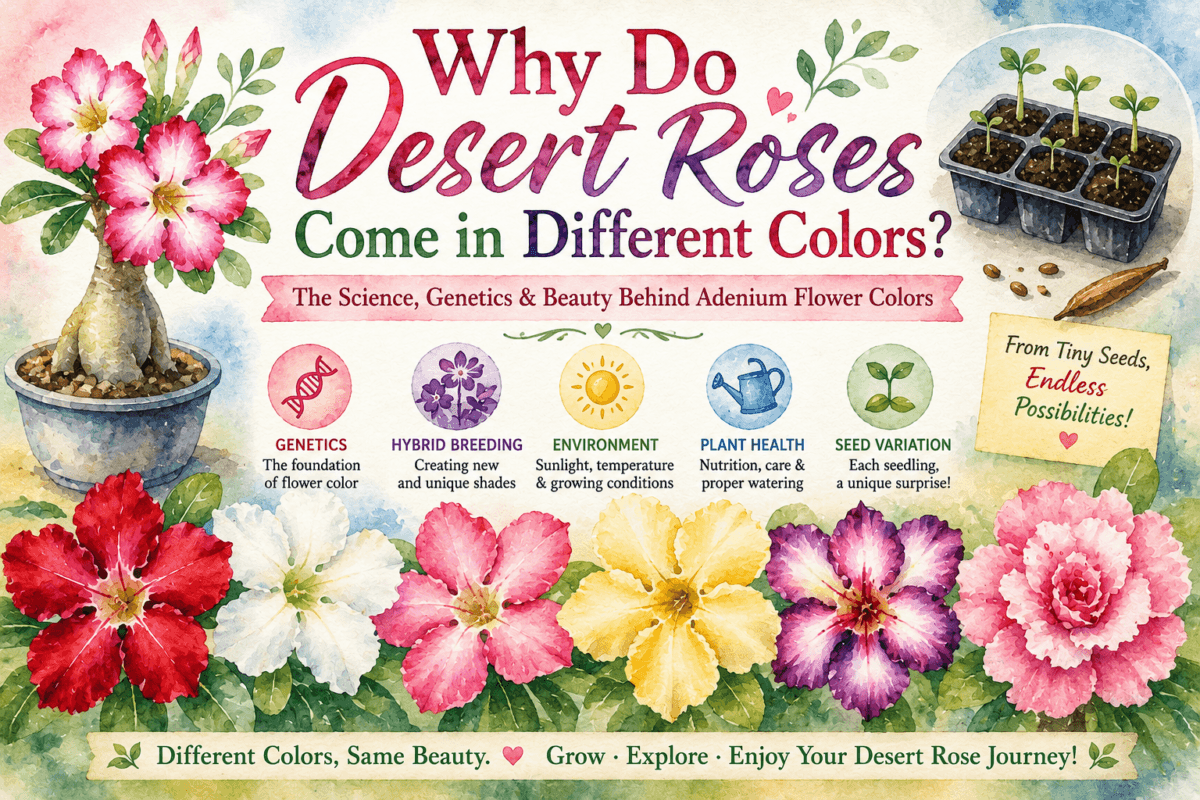
Why Do Desert Roses Come in Different Colors?Complete Guide to Adenium Flower Color, Genetics, Hybrids, and Seed-Grown Variation
Jun
Why Desert Rose Flower Colors Are So Different
Desert Rose, also known as Adenium, is famous for its thick swollen caudex and beautiful trumpet-shaped flowers. One of the most exciting things about growing Desert Rose is the wide range of flower colors.
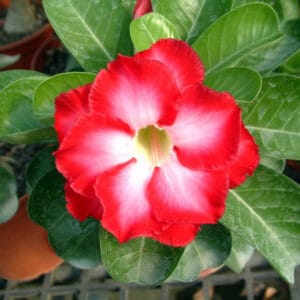
Some Desert Rose plants bloom in soft pink. Others produce deep red, pure white, purple, yellow, striped, bi-color, multi-color, single petal, double petal, or even unusual hybrid patterns.
This naturally leads many growers to ask:
Why do Desert Roses come in so many different colors?
The answer is a combination of genetics, hybrid breeding, seed-grown variation, plant maturity, growing conditions, and flower pigmentation.
Some colors are naturally inherited from parent plants. Some are created through selective breeding. Some may appear differently depending on temperature, sunlight, plant health, and age. And when Desert Rose is grown from seeds, every seedling can be slightly different.
This is one of the biggest reasons Adenium is so popular among collectors. You are not just growing a plant. You are growing a living surprise.
In this guide, we’ll explain why Desert Rose flowers have different colors, how genetics affects bloom color, why seed-grown Adenium may not match the parent plant exactly, and what growers should expect when planting Desert Rose seeds.
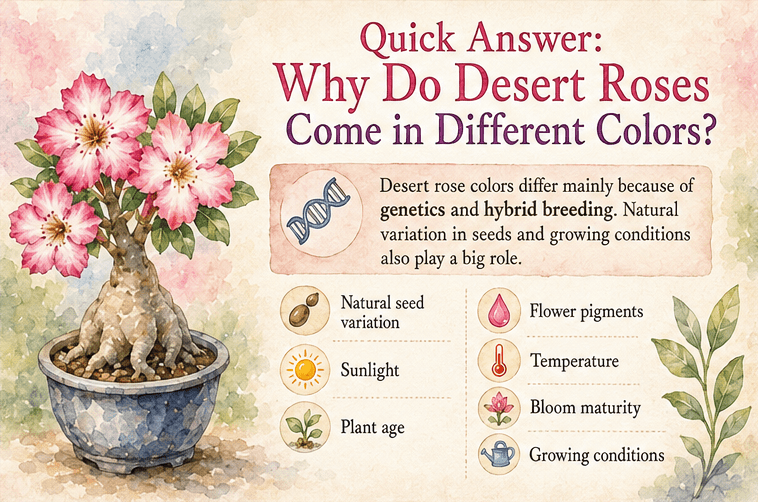
Quick Answer: Why Do Desert Roses Come in Different Colors?
Desert Roses come in different colors mainly because of genetics and hybrid breeding.
Adenium flowers contain natural pigments that create colors such as pink, red, white, purple, yellow, and bi-color patterns. Through selective breeding, growers have developed many hybrid Desert Rose varieties with more dramatic flower colors and petal forms.
Seed-grown Desert Rose plants can also show natural variation. Even seeds from the same parent plant or seed batch may produce flowers with different shades, patterns, petal shapes, and color intensity.
The main reasons Desert Rose colors vary include:
- Genetics
- Hybrid parent plants
- Natural seed variation
- Flower pigments
- Selective breeding
- Sunlight
- Temperature
- Plant age
- Plant health
- Bloom maturity
- Growing conditions
This is why Desert Rose seeds are exciting to grow. Each seedling may develop its own unique flower color and pattern.
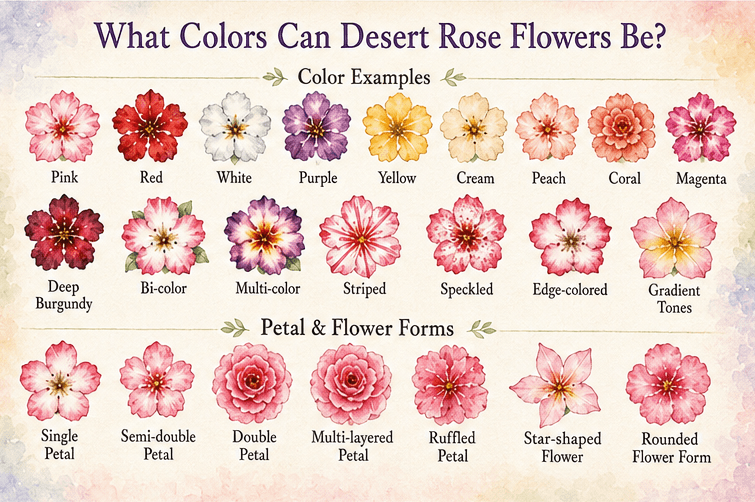
What Colors Can Desert Rose Flowers Be?
Desert Rose flowers can appear in many beautiful colors and combinations.
Common Adenium flower colors include:
- Pink
- Red
- White
- Purple
- Yellow
- Cream
- Peach
- Coral
- Magenta
- Deep burgundy
- Bi-color
- Multi-color
- Striped
- Speckled
- Edge-colored
- Gradient tones
Some flowers are simple and soft. Others are bold, dramatic, and highly patterned.
Desert Rose flowers may also come in different petal forms:
- Single petal
- Semi-double petal
- Double petal
- Multi-layered petal
- Ruffled petal
- Star-shaped flower
- Rounded flower form
Because of this variety, Desert Rose is one of the most collectible flowering succulents.
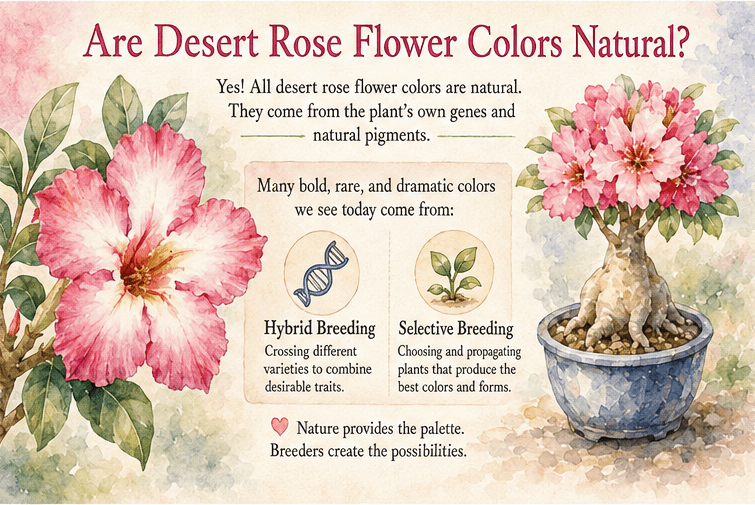
Are Desert Rose Flower Colors Natural?
Yes, Desert Rose flower colors are natural, but many modern colors come from hybrid breeding.
Wild Adenium plants usually have a more limited color range compared with modern hybrid varieties. Natural forms are often pink, red, or white-toned, depending on the species and region.
Modern Desert Rose varieties, however, have been selectively bred for:
- Brighter colors
- Larger flowers
- Stronger patterns
- Double petals
- Multi-color petals
- Unique edges
- Better contrast
- More ornamental appearance
This means many dramatic Desert Rose colors are not artificial. They are the result of plant genetics and breeding selection over time.
The color is part of the plant’s natural flower expression.
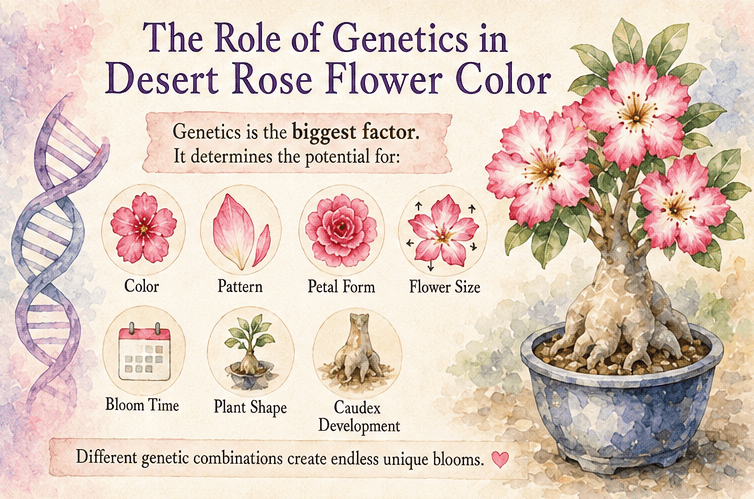
The Role of Genetics in Desert Rose Flower Color
Genetics is the biggest factor behind Desert Rose flower color.
Every Desert Rose plant carries genetic information from its parent plants. These genes influence flower color, flower shape, petal number, pattern, size, and blooming behavior.
When two Adenium plants are crossed, the seeds may inherit different combinations of traits from both parents.
This can affect:
- Flower color
- Petal pattern
- Color intensity
- Throat color
- Petal edge color
- Flower size
- Single or double petal form
- Blooming time
- Plant shape
- Caudex development
This is why seed-grown Adenium plants can be unpredictable.
Even if two seedlings come from the same seed pod, they may not bloom exactly the same.
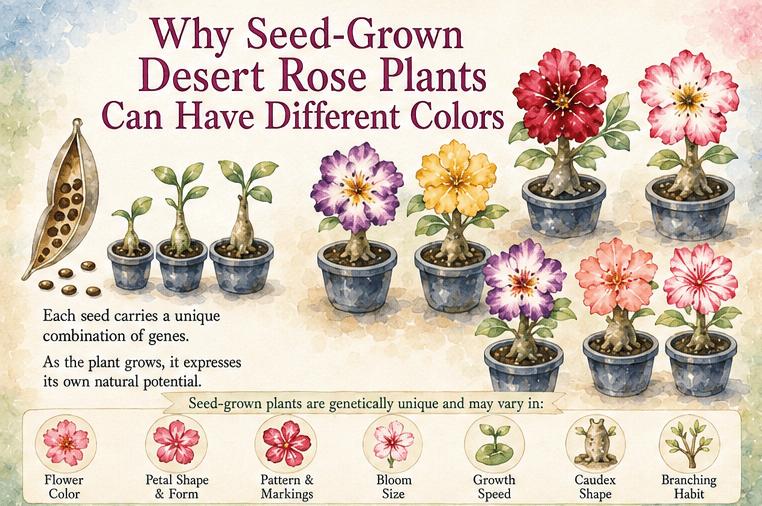
Why Seed-Grown Desert Rose Plants Can Have Different Colors
Growing Desert Rose from seed is exciting because each seedling can be genetically unique.
Unlike cuttings or grafted plants, seed-grown plants are not exact copies of the parent plant. They are new genetic combinations.
This means seedlings may vary in:
- Flower color
- Petal shape
- Petal count
- Pattern
- Bloom size
- Growth speed
- Caudex shape
- Branching habit
- Blooming age
For example, seeds from a pink parent plant may not always produce only pink flowers. If the plant has hybrid genetics, its seedlings may produce different shades or patterns.
Seeds from double petal parent plants may produce double, semi-double, or single flowers depending on genetics.
This natural variation is not a problem. It is one of the main attractions of growing Adenium from seed.
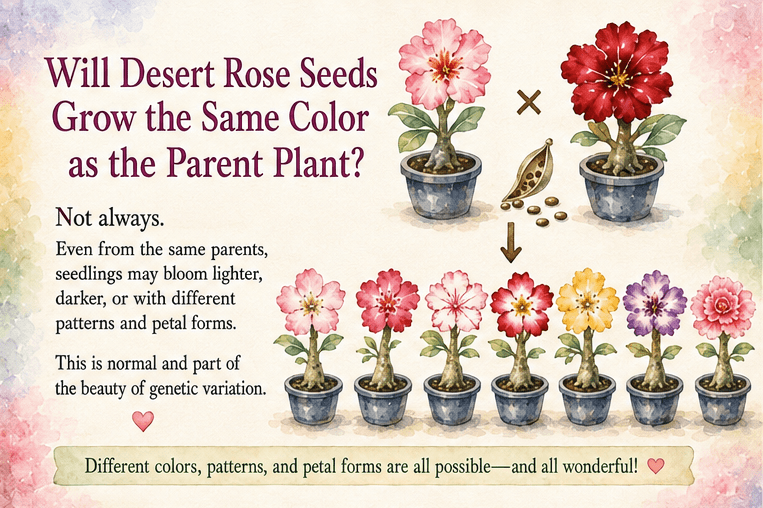
Will Desert Rose Seeds Grow the Same Color as the Parent Plant?
Not always.
This is one of the most important things beginners should understand.
Desert Rose seeds do not always produce plants that look exactly like the parent plant. A seedling may inherit traits from both parent plants, and hidden genetic traits may also appear.
Possible results from Desert Rose seeds include:
- Similar color to the parent
- Lighter color
- Darker color
- Different petal pattern
- Different throat color
- Different edge color
- Single petal instead of double petal
- Semi-double flowers
- Completely unexpected flower color
This does not mean the seeds are low quality. It is normal genetic variation.
If you want a guaranteed exact flower color, a grafted Adenium plant is more predictable.
If you enjoy surprise colors and unique plants, seeds are more exciting.
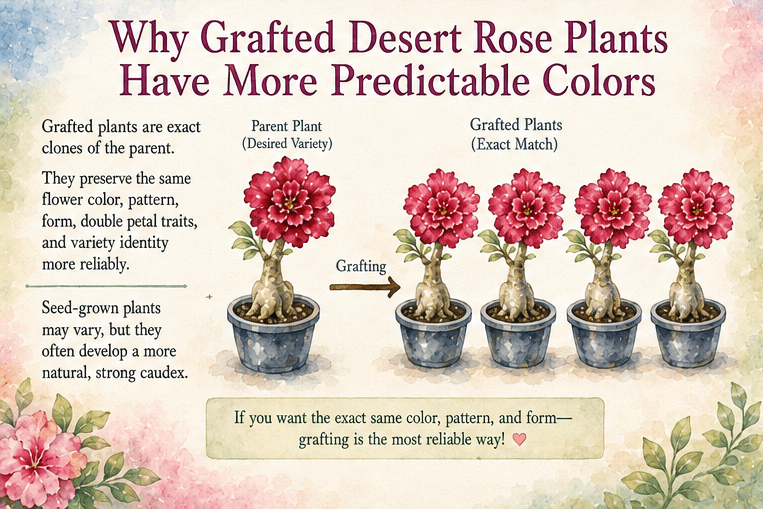
Why Grafted Desert Rose Plants Have More Predictable Colors
A grafted Desert Rose is made by attaching a branch from a known variety onto another Adenium rootstock.
Because the flowering branch comes from a specific plant, the flowers are usually much more predictable.
Grafted Adenium is often used for named varieties because it helps preserve:
- Exact flower color
- Exact petal form
- Known flower pattern
- Double petal traits
- Bloom size
- Variety identity
This is why many rare double petal or unusual color Adeniums are sold as grafted plants.
However, seed-grown plants have another advantage: they often develop a more natural caudex.
So the choice depends on your goal.
Choose grafted plants if you want predictable flowers.
Choose seeds if you enjoy variation, surprise, and natural caudex development.
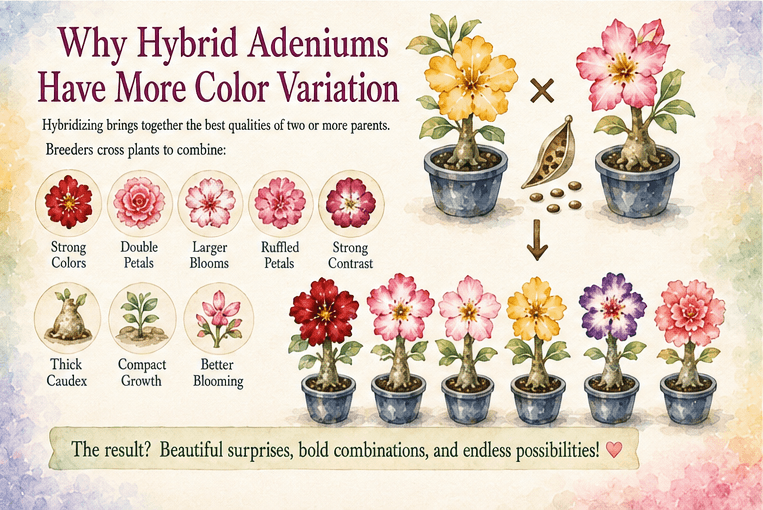
Why Hybrid Adeniums Have More Color Variation
Hybrid Adeniums are created by crossing different Adenium plants to combine desirable traits.
Breeders may select parent plants for:
- Strong red color
- Pure white petals
- Purple tones
- Yellow tones
- Double petals
- Large flowers
- Ruffled petals
- Strong bi-color contrast
- Thick caudex
- Compact growth
- Better blooming
When these plants are crossed, the seedlings can show many different results.
Some seedlings may resemble one parent more strongly. Some may show a mix of both parents. Some may display unexpected hidden traits.
This is why hybrid Adenium seeds can produce very interesting flower colors.
For collectors, this variation is part of the fun.
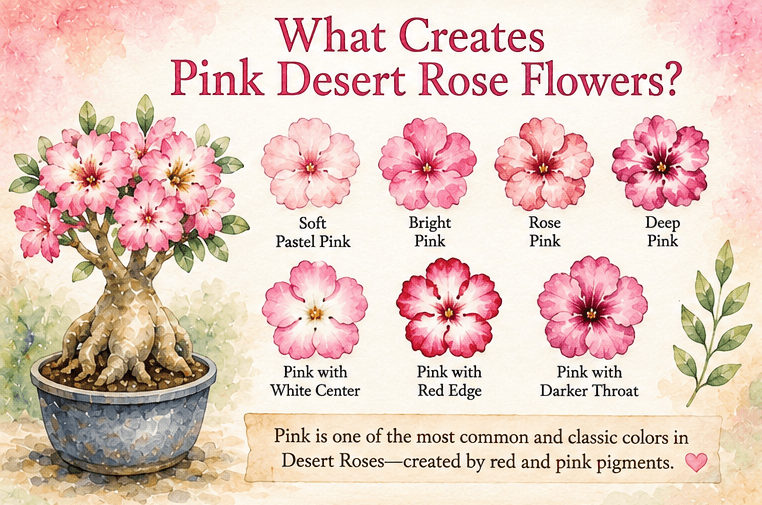
What Creates Pink Desert Rose Flowers?
Pink is one of the most common and classic Desert Rose flower colors.
Pink Desert Rose flowers may range from:
- Soft pastel pink
- Bright pink
- Rose pink
- Deep pink
- Pink with white center
- Pink with red edge
- Pink with darker throat
Pink tones are common because many Adenium varieties naturally carry red or pink pigments.
Pink flowers are popular because they look soft, elegant, and classic. They also pair beautifully with the thick caudex and green leaves of the plant.
For beginners, pink Adenium is often one of the easiest colors to find.
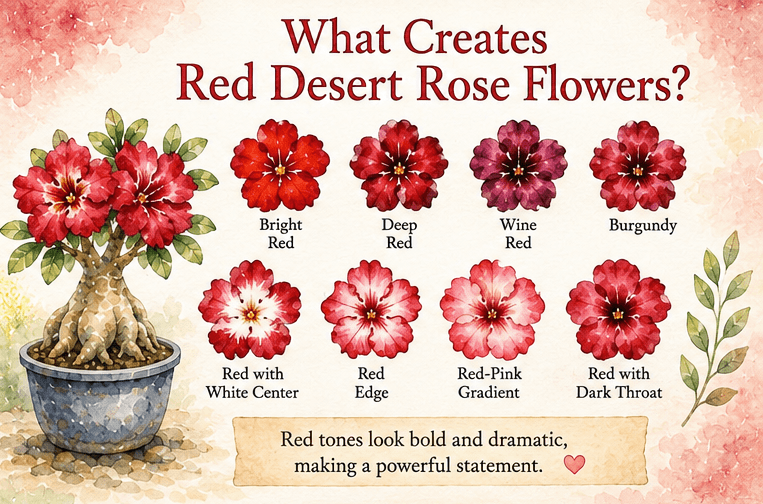
What Creates Red Desert Rose Flowers?
Red Desert Rose flowers are created by stronger red pigmentation in the petals.
Red Adenium flowers may appear as:
- Bright red
- Deep red
- Wine red
- Burgundy
- Red with white center
- Red edge
- Red and pink gradient
- Red with dark throat
Red flowers often look bold and dramatic, making them popular for collectors and product photos.
Deep red varieties may sometimes appear darker or lighter depending on sunlight, temperature, bloom age, and plant health.
A red flower may look intense when it first opens, then soften slightly as the bloom ages.
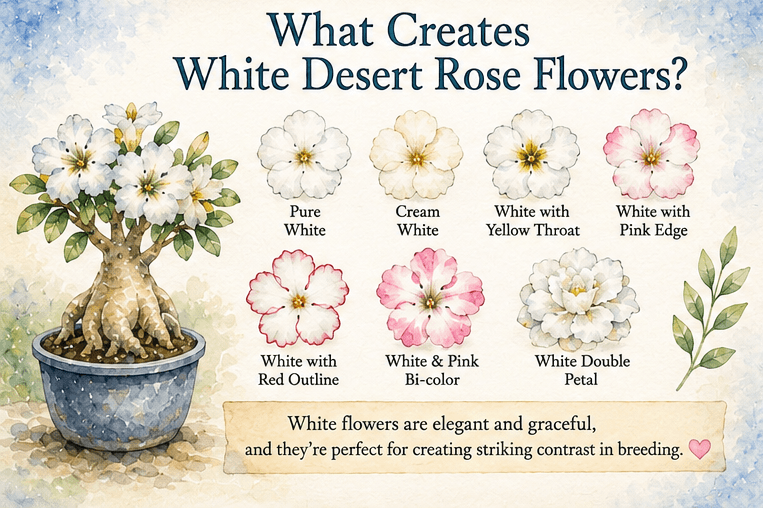
What Creates White Desert Rose Flowers?
White Desert Rose flowers usually have less visible red or pink pigmentation in the petals.
White Adenium flowers may be:
- Pure white
- Cream white
- White with yellow throat
- White with pink edge
- White with red outline
- White and pink bi-color
- White double petal form
Pure white flowers are especially elegant and clean-looking. They are popular for minimalist gardens, indoor plant styling, and soft-color collections.
White flowers can also be useful in breeding because they may help create contrast when crossed with strong-colored varieties.
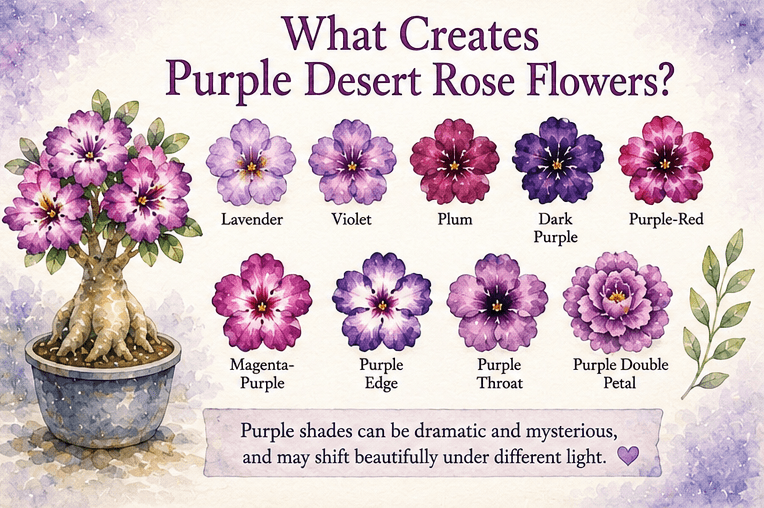
What Creates Purple Desert Rose Flowers?
Purple Desert Rose flowers usually come from the expression of darker pink, red, magenta, or violet-toned pigments.
True deep purple Adeniums are often considered more unusual than common pink or red types.
Purple-toned flowers may appear as:
- Lavender
- Violet
- Plum
- Dark purple
- Purple-red
- Magenta-purple
- Purple edge
- Purple throat
- Purple double petal flower
Purple Adenium flowers can look very dramatic, especially when combined with white centers or darker edges.
Because purple tones may vary under different lighting, the same flower may look slightly different in photos, shade, or full sun.
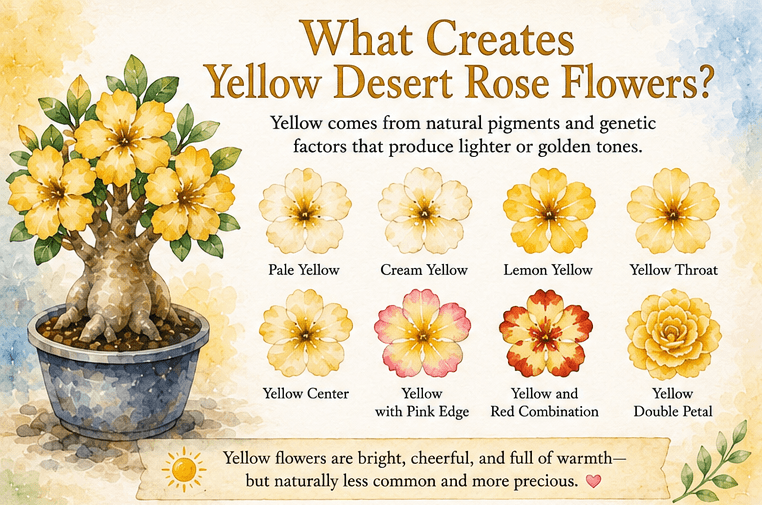
What Creates Yellow Desert Rose Flowers?
Yellow Desert Rose flowers are often more unusual and highly attractive.
Yellow tones may appear as:
- Pale yellow
- Cream yellow
- Lemon yellow
- Yellow throat
- Yellow center
- Yellow with pink edge
- Yellow and red combination
- Yellow double petal form
Some yellow varieties may be softer in color than red or pink types. Yellow flowers can also be influenced by bloom age and growing conditions.
A flower may open with a stronger yellow tone and fade lighter over time.
Yellow Adeniums are popular because they look bright, cheerful, and less common.
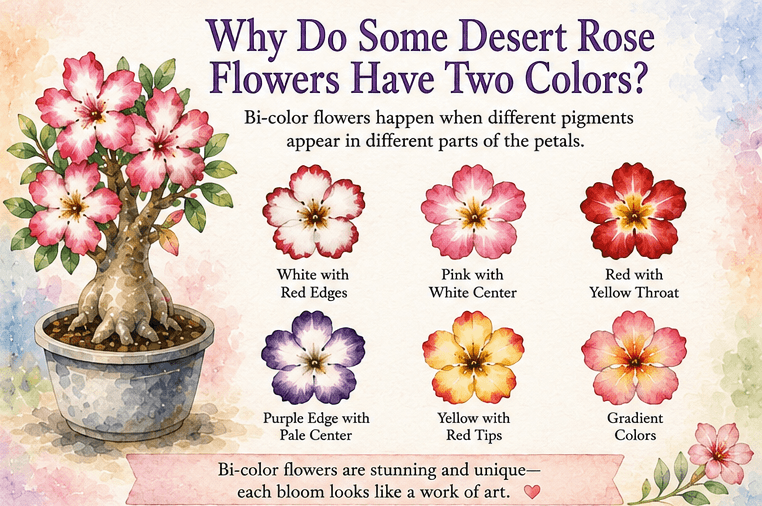
Why Do Some Desert Rose Flowers Have Two Colors?
Bi-color Desert Rose flowers happen when different pigments appear in different areas of the petals.
A flower may have:
- White petals with red edges
- Pink petals with white center
- Red petals with yellow throat
- Purple edge with pale center
- Yellow petals with red tips
- Striped petals
- Gradient color from center to edge
Bi-color patterns are usually controlled by genetics. Hybrid breeding can increase the chance of dramatic patterns.
Bi-color Desert Rose flowers are especially popular because they look more complex and eye-catching than solid colors.
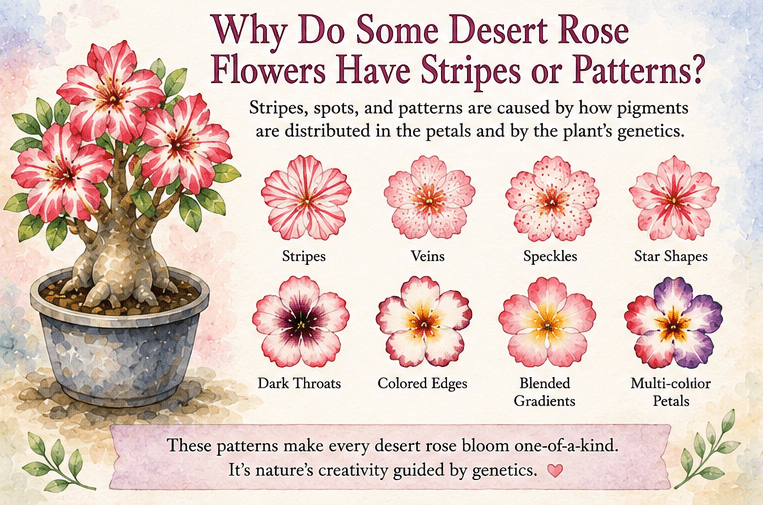
Why Do Some Desert Rose Flowers Have Stripes or Patterns?
Striped and patterned Adenium flowers are caused by how pigments are distributed across the petals.
Instead of the pigment spreading evenly, it may appear in lines, edges, patches, or gradients.
Patterns may include:
- Stripes
- Veins
- Speckles
- Star shapes
- Dark throat
- Colored edges
- Blended gradients
- Multi-color petals
These patterns are often inherited genetically, but their appearance may also change slightly depending on bloom maturity and growing conditions.
A patterned Adenium can look different from one bloom cycle to another.
This makes it especially interesting for collectors.
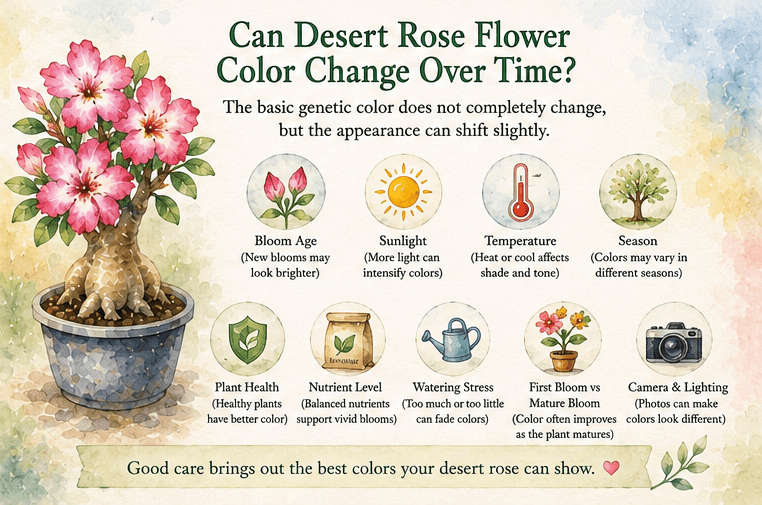
Can Desert Rose Flower Color Change Over Time?
Yes, the appearance of Desert Rose flower color can change slightly over time, but the plant’s basic genetic color does not completely change.
A flower may look different because of:
- Bloom age
- Sunlight exposure
- Temperature
- Season
- Plant health
- Nutrient level
- Watering stress
- First bloom vs mature bloom
- Camera lighting
Young plants may produce flowers that are smaller, lighter, or less developed at first. As the plant matures, the flowers may become fuller, stronger, or more consistent.
However, a genetically white Adenium will not permanently become deep red just because of care changes.
Care can improve flower quality, but genetics sets the foundation.
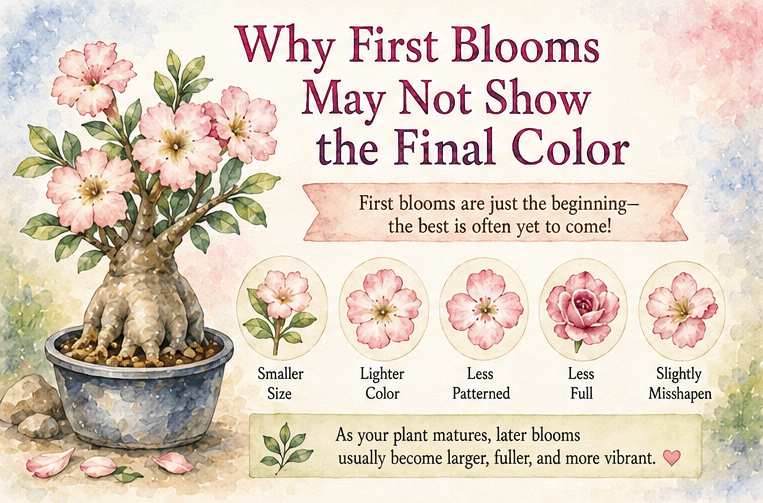
Why First Blooms May Not Show the Final Color
A young Desert Rose plant’s first bloom may not show its full mature flower quality.
First blooms may be:
- Smaller
- Lighter in color
- Less patterned
- Less full
- Slightly misshapen
- Less stable
- Different from later blooms
This is normal, especially for seed-grown Adenium.
As the plant matures and becomes stronger, future blooms may look better.
A double petal plant may produce less complete first flowers. A patterned flower may show stronger markings later. Color intensity may improve under better light and warmer conditions.
For this reason, do not judge a seed-grown Adenium too quickly from its first bloom.
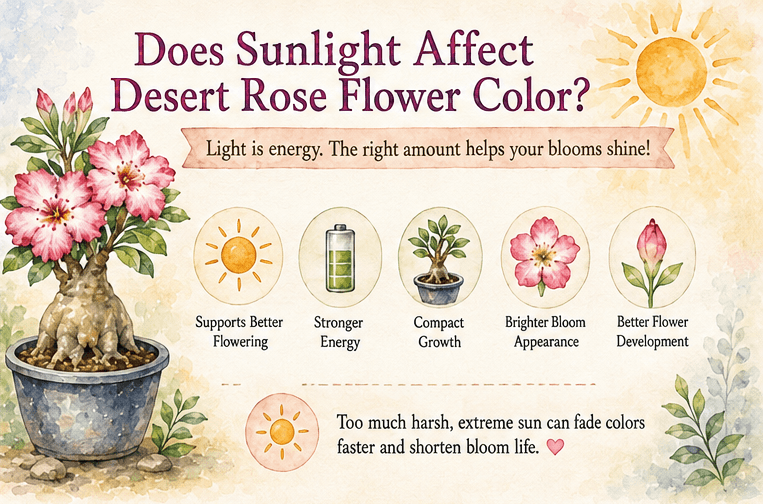
Does Sunlight Affect Desert Rose Flower Color?
Sunlight can affect how strong and healthy Desert Rose blooms look.
Adenium needs strong light to grow well and flower properly. Without enough light, the plant may produce fewer flowers, weaker blooms, or pale growth.
Strong light can help support:
- Better flowering
- Stronger plant energy
- More compact growth
- Brighter bloom appearance
- Better flower development
However, extreme harsh sun may fade some flowers faster or cause petal stress in very hot conditions.
The best light depends on your climate. In many warm regions, mature Desert Rose plants grow well with strong sunlight, especially morning sun and bright outdoor light.
If moving a plant from shade to full sun, introduce stronger light gradually to prevent sunburn.
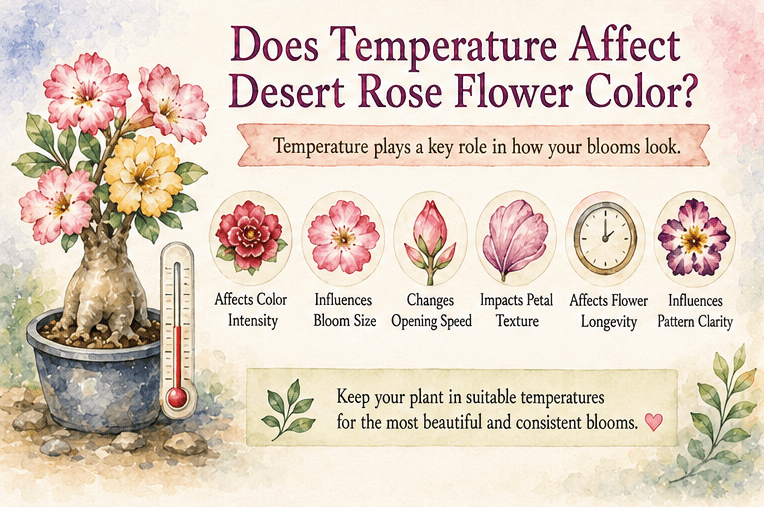
Does Temperature Affect Desert Rose Flower Color?
Temperature can influence flower appearance.
Cooler or warmer conditions may affect:
- Color intensity
- Bloom size
- Opening speed
- Petal texture
- Flower longevity
- Pattern clarity
In some plants, cooler conditions may make colors appear deeper. In hot conditions, some flowers may fade faster or appear lighter as they age.
Desert Rose grows best in warm temperatures, but extreme heat combined with dry conditions may shorten flower life.
Stable warmth usually supports better growth and more consistent blooming.
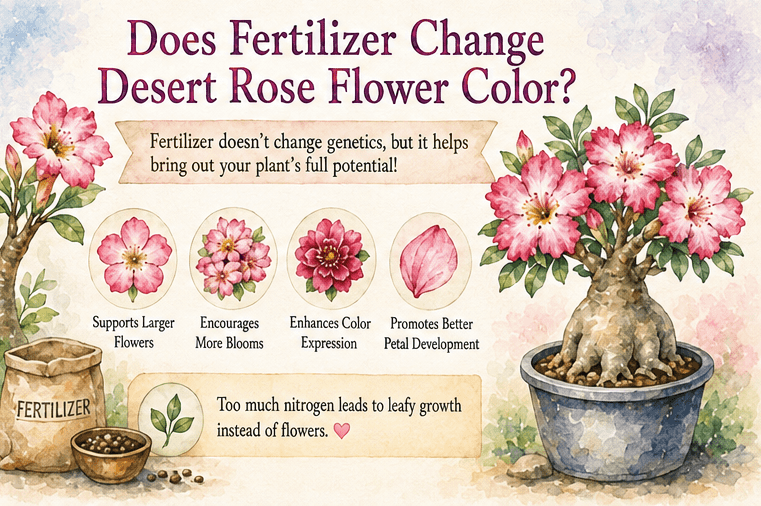
Does Fertilizer Change Desert Rose Flower Color?
Fertilizer does not usually change the genetic color of a Desert Rose flower.
However, proper nutrition can improve overall plant health, which may support better bloom quality.
A healthy plant may produce:
- Larger flowers
- More blooms
- Stronger color expression
- Better petal development
- Longer bloom cycles
Too much fertilizer, especially too much nitrogen, can cause leafy growth instead of flowers.
For blooming, use balanced feeding during active growth and avoid overfeeding.
If your Desert Rose is not blooming well, check sunlight first before adding more fertilizer.
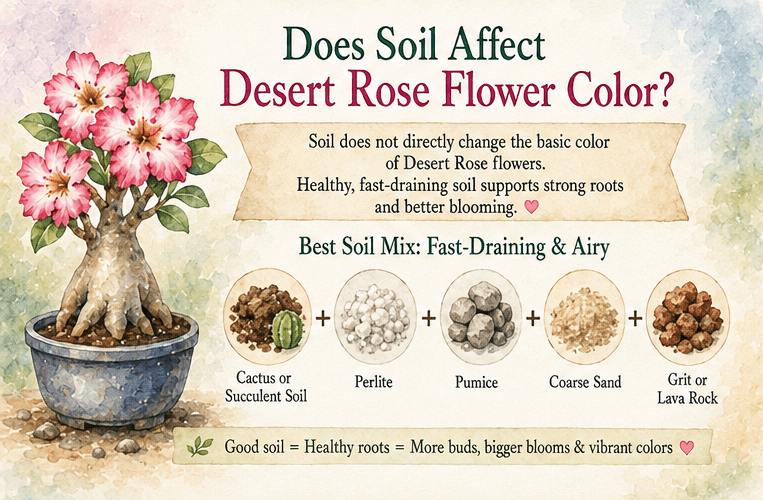
Does Soil Affect Desert Rose Flower Color?
Soil does not usually change the basic flower color of Desert Rose.
However, soil strongly affects root health. Healthy roots support healthier growth and better blooming.
Adenium needs fast-draining soil because its roots dislike staying wet.
Poor soil can cause:
- Root rot
- Weak growth
- Yellow leaves
- Fewer flowers
- Poor bloom quality
- Plant decline
Good soil supports strong roots, and strong roots support better flowers.
For Adenium, use a fast-draining mix such as:
- Cactus or succulent soil
- Perlite or pumice
- Coarse sand
- Grit or lava rock if needed
The soil may not change the flower color directly, but it affects whether the plant has enough strength to bloom well.
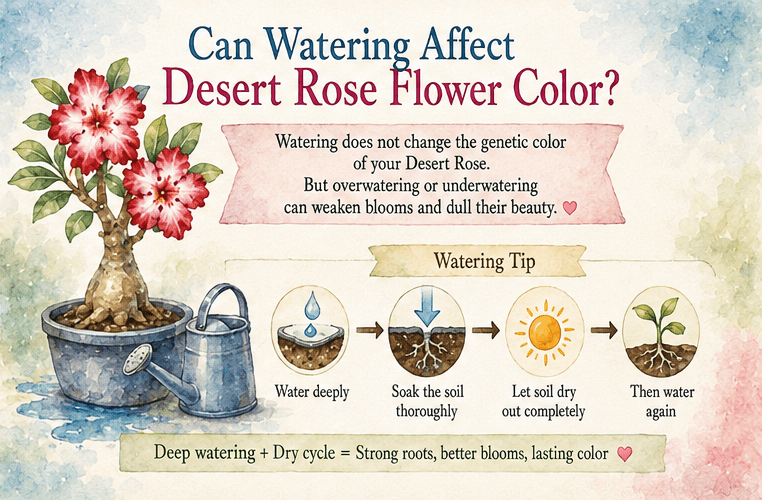
Can Watering Affect Desert Rose Flower Color?
Watering does not change the genetic flower color, but poor watering can affect flower quality.
If Desert Rose is overwatered, roots may become stressed or rotten. A stressed plant may stop blooming or produce weak flowers.
If Desert Rose is underwatered during active growth, buds may drop or flowers may not develop fully.
Good watering supports better blooming.
The best watering rule is:
Water deeply, then let the soil dry before watering again.
Avoid constant wet soil. Desert Rose stores water in its caudex and roots, so it prefers drying periods between waterings.
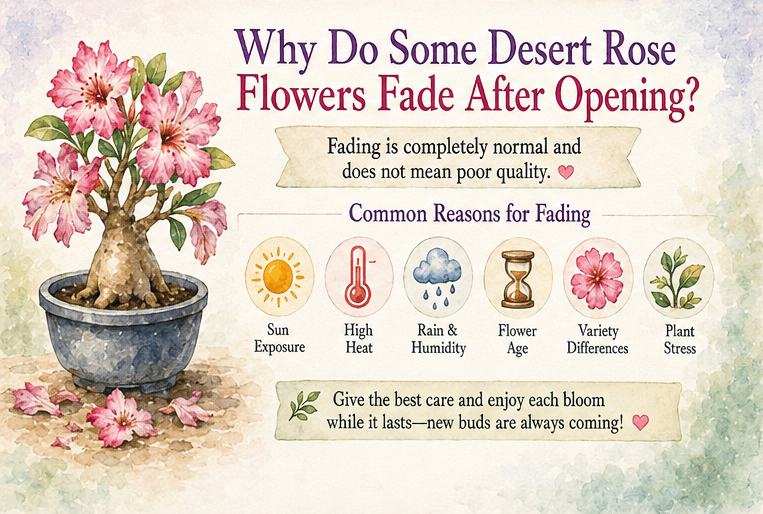
Why Do Some Desert Rose Flowers Fade After Opening?
It is normal for some Desert Rose flowers to fade as they age.
A flower may open with strong color, then become lighter after several days.
Fading can be influenced by:
- Sun exposure
- Heat
- Rain
- Flower age
- Variety
- Petal thickness
- Plant stress
Dark red or purple flowers may soften over time. Yellow or pink flowers may become paler. Bi-color patterns may become less intense as petals mature.
This is normal and does not mean the plant is unhealthy.
To keep flowers looking better longer, protect them from harsh rain, extreme heat, and severe stress.
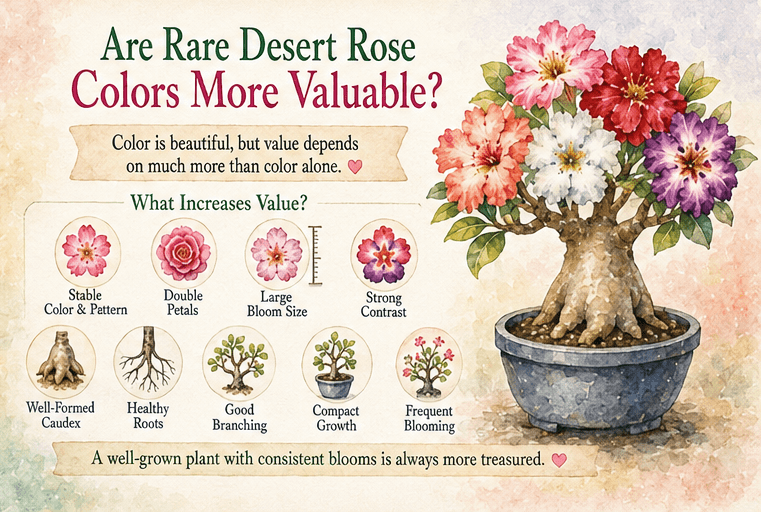
Are Rare Desert Rose Colors More Valuable?
Rare colors can be more collectible, but value depends on more than color alone.
A Desert Rose may be more valuable if it has:
- Rare flower color
- Stable flower pattern
- Double petal form
- Large bloom size
- Strong contrast
- Thick caudex
- Healthy roots
- Balanced branching
- Compact growth
- Good blooming habit
A rare flower on a weak plant may not be as attractive as a common-colored plant with a beautiful caudex and strong structure.
For collectors, the best Adenium combines flower beauty and plant form.
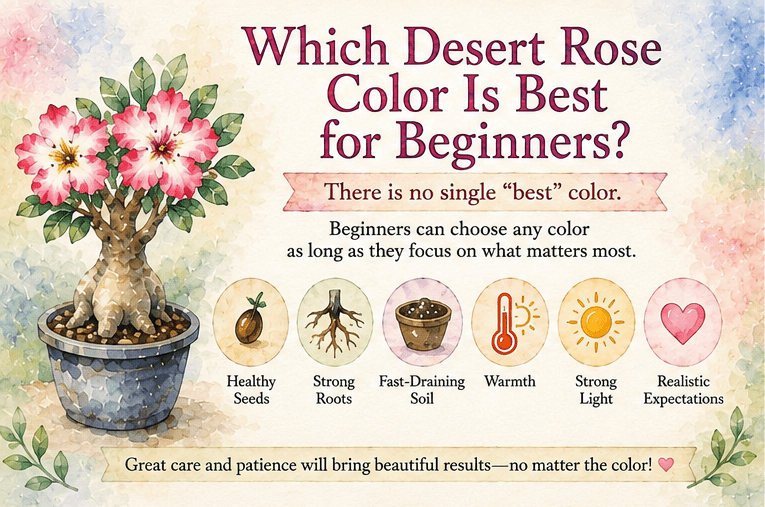
Which Desert Rose Color Is Best for Beginners?
There is no single best color for beginners.
Beginners can grow pink, red, white, yellow, purple, single petal, or double petal Adenium as long as the plant receives proper care.
A better beginner choice is based on:
- Fresh seeds
- Healthy seedlings
- Strong root growth
- Good germination rate
- Fast-draining soil
- Warm growing conditions
- Strong light
- Clear expectations
If growing from seed, choose a color or mix that excites you, but remember that seed-grown flowers can vary.
Mixed Desert Rose seeds are especially fun for beginners who enjoy surprise blooms.
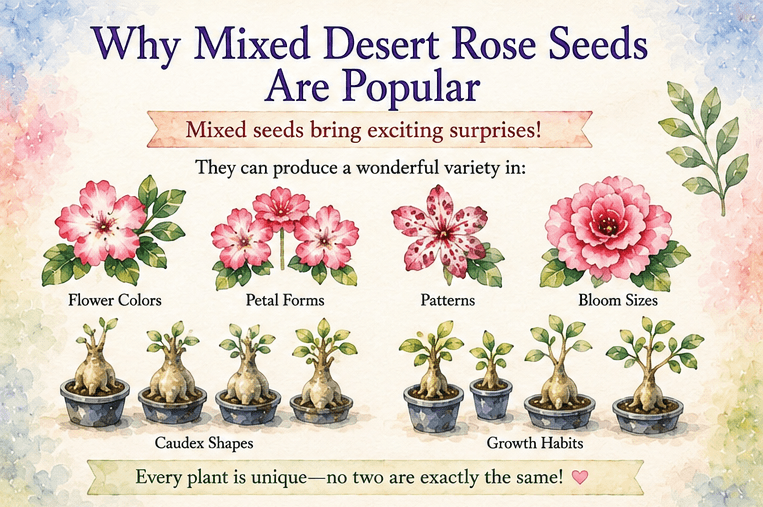
Why Mixed Desert Rose Seeds Are Popular
Mixed Desert Rose seeds are popular because they offer variety and surprise.
A mixed seed pack may produce plants with different:
- Flower colors
- Petal forms
- Patterns
- Bloom sizes
- Caudex shapes
- Growth habits
This makes growing from seed more exciting. Instead of knowing exactly what every plant will become, you get to watch each seedling reveal its own character over time.
For ecommerce seed stores, this is a strong selling point.
A good message for mixed Adenium seeds is:
Each seed-grown Adenium may develop its own unique flower color, pattern, and form, making every plant a one-of-a-kind growing experience.
This helps customers understand variation while making it feel valuable.
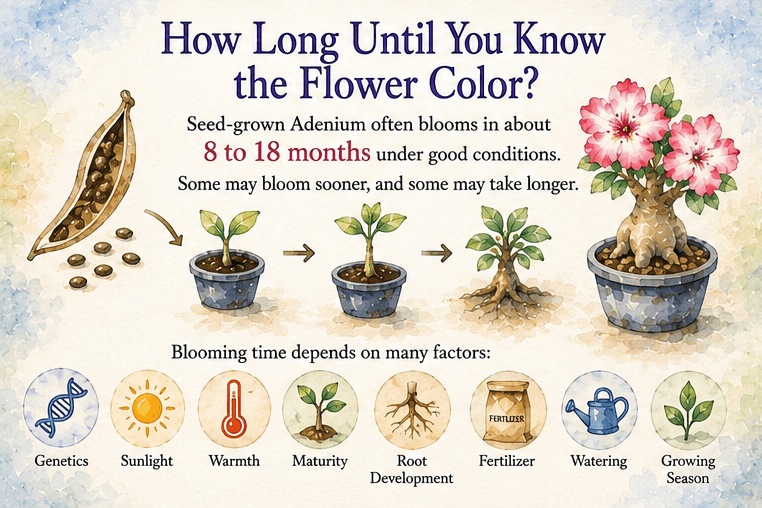
How Long Until You Know the Flower Color?
You usually need to wait until the Desert Rose blooms to know its flower color.
Seed-grown Adenium often blooms in about:
8 to 18 months under good conditions
Some plants may bloom earlier, while others may take two years or longer.
Blooming time depends on:
- Genetics
- Sunlight
- Warmth
- Plant maturity
- Root health
- Fertilizer
- Watering
- Growing season
Before blooming, you can evaluate the plant’s caudex, leaves, and growth habit, but the flower color usually remains unknown.
This waiting period is part of the reward of growing Desert Rose from seeds.
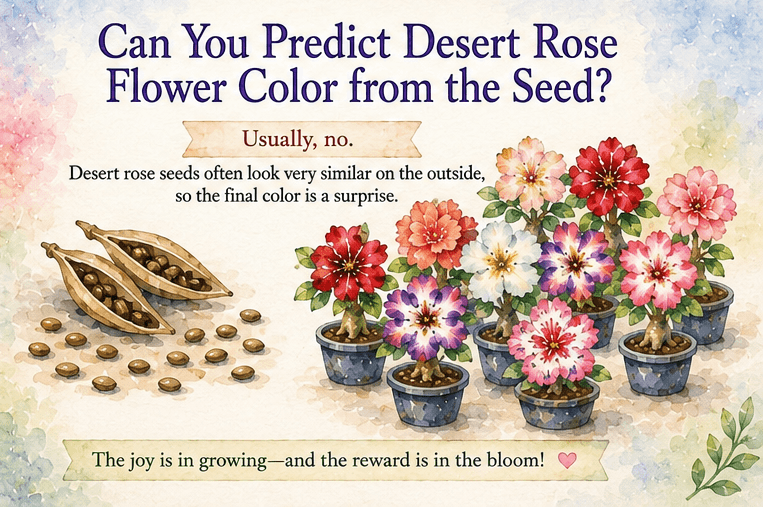
Can You Predict Desert Rose Flower Color from the Seed?
Usually, no.
You generally cannot know the exact flower color just by looking at the seed.
Desert Rose seeds often look similar even if they come from different flower colors. The genetic information is inside the seed, but it is not visible from the outside.
You may have a better idea if you know the parent plants, but even then, the exact result is not guaranteed.
For seed-grown Adenium, the final flower color is revealed only when the plant blooms.
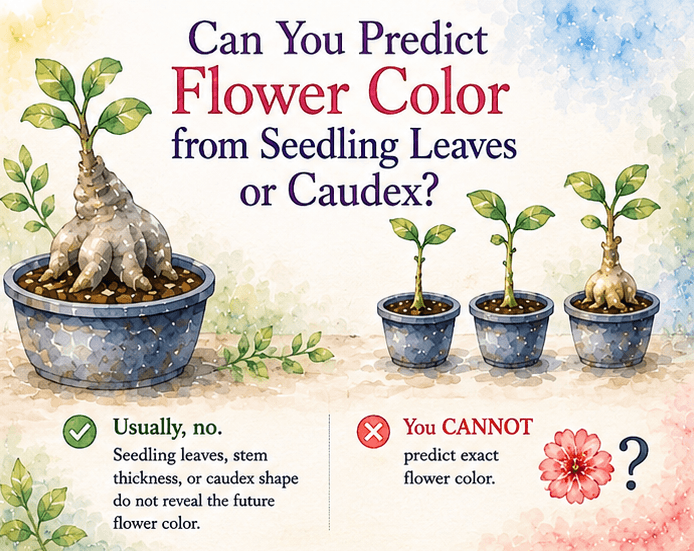
Can You Predict Flower Color from Seedling Leaves or Caudex?
Usually, no.
Seedling leaf shape, stem thickness, and caudex growth do not reliably reveal flower color.
A strong seedling does not necessarily mean a dark flower. A small seedling does not necessarily mean a pale flower.
Flower color is controlled by genetic traits that usually only become visible when the plant blooms.
You can judge seedling health before blooming, but not exact flower color.
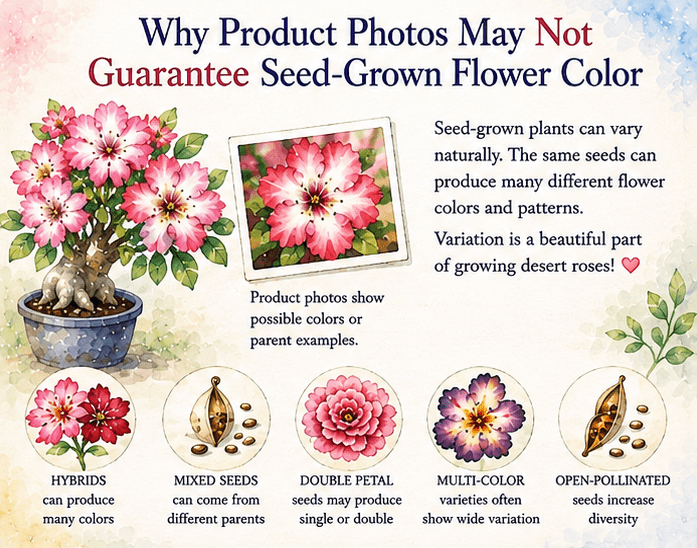
Why Product Photos May Not Guarantee Seed-Grown Flower Color
When buying Desert Rose seeds, product photos often show possible flower colors or parent plant examples.
However, seed-grown plants may not bloom exactly like the photos.
This is especially true for:
- Hybrid Adenium seeds
- Mixed color seeds
- Double petal seeds
- Multi-color varieties
- Open-pollinated seeds
Product photos are helpful for showing potential, but seeds naturally produce variation.
For seed sellers, it is important to explain this clearly to build trust.
A good note could be:
Photos show possible flower styles. Seed-grown Adenium may vary naturally in color, pattern, and petal form.
This keeps expectations realistic while still highlighting the excitement of growing unique plants.
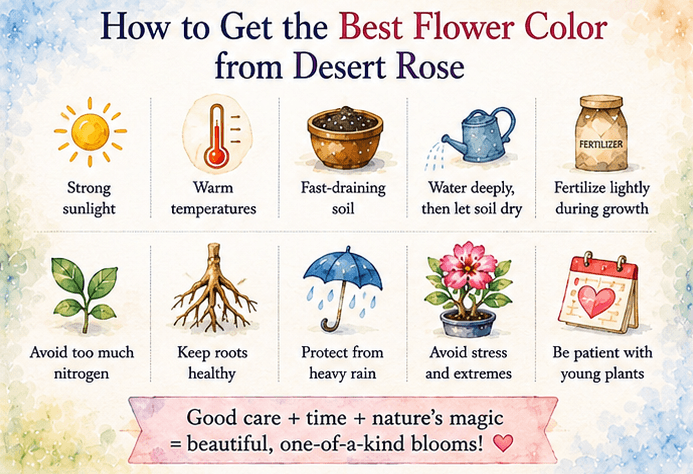
How to Get the Best Flower Color from Desert Rose
You cannot change the plant’s genetic color, but you can help it produce its best blooms.
To support strong flower color:
- Give strong sunlight
- Keep the plant warm
- Use fast-draining soil
- Avoid overwatering
- Water deeply, then let soil dry
- Fertilize lightly during active growth
- Avoid too much nitrogen
- Keep roots healthy
- Protect from heavy rain
- Avoid sudden stress
- Be patient with young plants
A healthy Desert Rose usually produces better flowers than a stressed plant.
The goal is not to force color. The goal is to help the plant express its natural potential.
Common Misconceptions About Desert Rose Flower Colors
“Seeds Always Match the Flower Photo”
Not always. Seed-grown Adenium can vary naturally, especially hybrids and mixed seeds.
“Fertilizer Can Change the Flower Color Completely”
Fertilizer can support bloom quality, but it does not completely change genetic flower color.
“A Young Plant’s First Bloom Is Final”
Not always. First blooms may be smaller, lighter, or less developed. Later blooms may improve.
“Rare Color Means Better Plant”
Not necessarily. Plant health, caudex shape, roots, and blooming habit also matter.
“Double Petal Seeds Always Produce Double Petal Flowers”
Not always. Seed-grown double petal Adenium may produce single, semi-double, or double flowers depending on genetics.
“Leaf Shape Can Tell Flower Color”
Usually no. Flower color is normally confirmed only when the plant blooms.
Desert Rose Color FAQ
Why are there different colors of Desert Rose?
Desert Rose comes in different colors because of genetics, hybrid breeding, natural pigmentation, and seed-grown variation.
Will Desert Rose seeds grow the same color as the parent plant?
Not always. Seed-grown Adenium may vary in flower color, pattern, and petal form.
Can one Desert Rose plant produce different colored flowers?
A single plant usually produces flowers based on its genetics. However, grafted plants with multiple varieties can produce different colored flowers on different branches.
Can Desert Rose flower color change?
The genetic color does not completely change, but flowers may look lighter, darker, or different depending on bloom age, sunlight, temperature, and plant health.
Why did my Desert Rose bloom a different color than the photo?
Seed-grown Adenium can vary naturally. Product photos often show possible flower styles, not guaranteed exact results.
What is the rarest Desert Rose color?
Rarity depends on variety and region, but unusual yellow, deep purple, black-purple, strong multi-color, or stable double petal forms are often considered more collectible.
Are double petal Desert Rose colors more valuable?
They can be more collectible, especially if the color is rare or stable, but value also depends on caudex shape, plant health, and bloom performance.
How long does it take to know the flower color?
Seed-grown Desert Rose may bloom in about 8 to 18 months under good conditions, though some plants take longer.
Can fertilizer make Desert Rose flowers brighter?
Good nutrition can support healthier blooms, but fertilizer cannot completely change the plant’s genetic flower color.
Are mixed Desert Rose seeds worth growing?
Yes. Mixed seeds are great if you enjoy surprise colors, natural variation, and growing unique Adenium plants from seed.
Final Thoughts: Desert Rose Colors Are Part of the Surprise
Desert Rose flowers come in many colors because Adenium is genetically diverse and widely hybridized. Through natural variation and selective breeding, growers can enjoy pink, red, white, purple, yellow, bi-color, striped, single petal, double petal, and many other flower forms.
For seed growers, this variation is one of the most exciting parts of Adenium.
A seed-grown Desert Rose may not look exactly like the parent plant or product photo, but that is part of its charm. Every seedling has the potential to become something unique.
The best way to enjoy Desert Rose color variation is to grow with realistic expectations:
Seeds may vary.
Hybrids can surprise you.
First blooms may improve later.
Strong care helps flowers show their best color.
Every plant has its own character.
Whether your Desert Rose blooms pink, red, white, yellow, purple, single, double, or multi-color, the experience of growing it from seed makes the final flower even more rewarding.

Start Your Desert Rose Journey from Seeds
Growing Desert Rose from seeds is one of the most rewarding ways to enjoy Adenium. Explore our selected Desert Rose seeds and start growing your own unique plants with beautiful shapes, vibrant blooms, and natural caudex development.
Recommended Desert Rose SeedsShop All

 1
1 Mixed
Mixed
 1Mixed
 1Mixed

 1
1
 1Mixed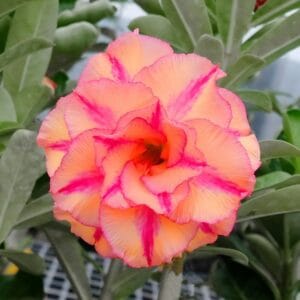
 1Mixed
 1Mixed
 1Mixed
 1Mixed
 1Mixed
 1Mixed
 1Mixed
 1Mixed
 1Mixed
 1Mixed
 1Mixed
 1Mixed
 1Mixed
 1Mixed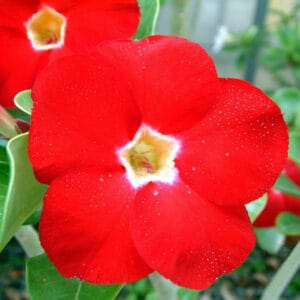
 1Mixed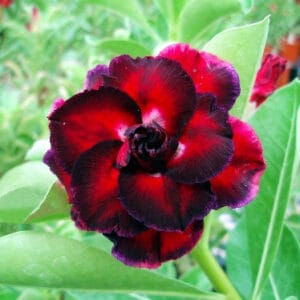
 1Mixed
 1Mixed
 1Mixed
 1Mixed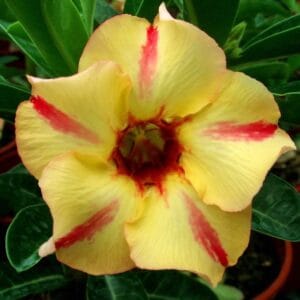
 1Mixed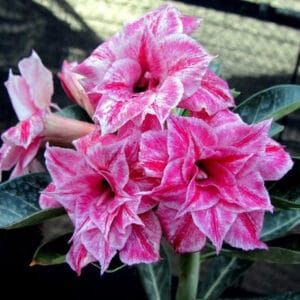
 1Mixed
 1Mixed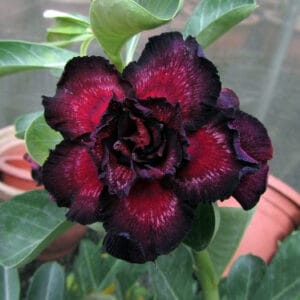
 1Mixed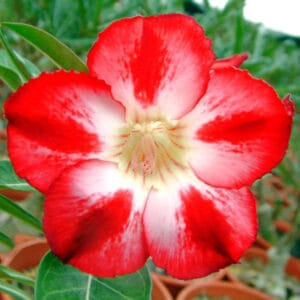
 1Mixed
 1Mixed
 1Mixed
 1Mixed

 1
1
 1Mixed
 1Mixed
 1Mixed
