

Plant Care & Troubleshooting
Why Are My Plants Growing Tall and Weak? Causes and Fixes for Leggy Growth

May
Tall and Weak Plants Are Usually Asking for Better Light
If your plants are growing tall, thin, and weak instead of compact, full, and healthy, you are likely dealing with leggy growth. This is one of the most common problems for beginner gardeners, especially when growing plants indoors, starting seeds, or keeping plants near a window with limited sunlight.
A leggy plant often looks stretched. The stem becomes long and thin, the leaves may be spaced far apart, and the plant may lean toward the light source. Some plants may even fall over because the stem is not strong enough to support the top growth.
The good news is that leggy growth is usually not mysterious. In most cases, plants grow tall and weak because they are not receiving enough light. When a plant cannot get enough light, it stretches upward or sideways in search of more. This is a natural survival response, but it often leads to weak stems, poor growth, fewer flowers, and lower productivity.
However, light is not the only possible cause. Tall, weak plants can also be caused by overcrowding, too much nitrogen fertilizer, warm indoor temperatures, poor airflow, incorrect watering, or seedlings staying too long in small trays.
In this complete guide, you’ll learn why plants grow tall and weak, how to fix leggy growth, how to save stretched seedlings, and how to prevent the problem from happening again.
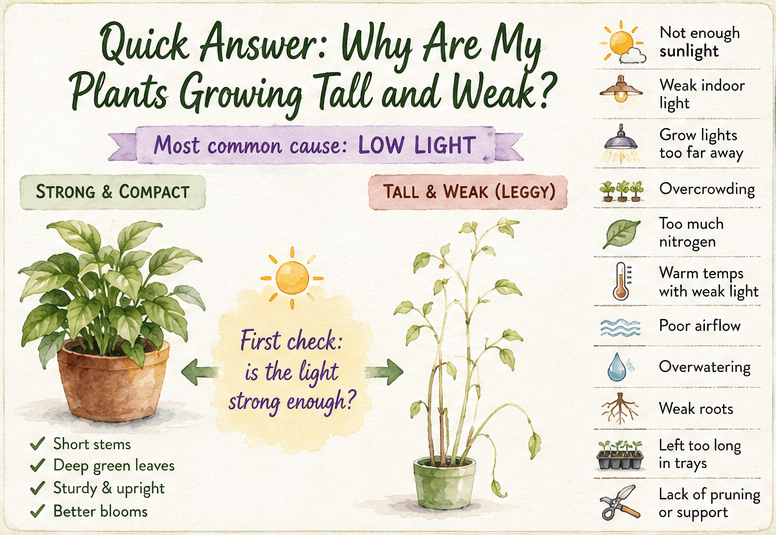
Why Are My Plants Growing Tall and Weak?
Plants usually grow tall and weak because they are not getting enough light. When light is too weak, plants stretch toward the strongest light source. This creates long, thin stems and wide gaps between leaves.
Common causes include:
- Not enough sunlight
- Weak indoor window light
- Grow lights placed too far away
- Overcrowded seedlings
- Too much nitrogen fertilizer
- Warm temperatures with weak light
- Poor airflow
- Overwatering or weak root development
- Seedlings staying too long in starter trays
- Lack of pruning or support
The most common cause is low light.
The first thing to check is simple:
Is your plant receiving enough strong light for the type of plant you are growing?
If the answer is no, fixing the light situation should be your first priority.
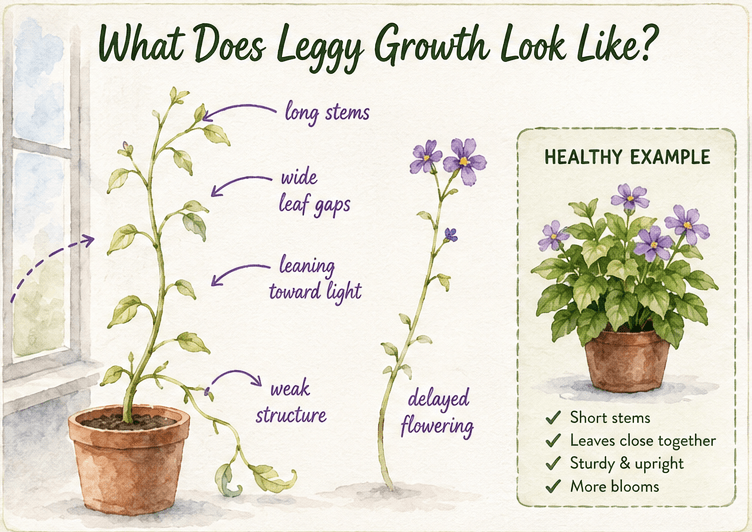
What Does Leggy Growth Look Like?
Leggy growth is easy to recognize once you know what to look for. A healthy plant usually grows compact, balanced, and sturdy. A leggy plant looks stretched and weak.
Signs of leggy growth include:
- Long, thin stems
- Large gaps between leaves
- Pale green or yellowish leaves
- Plant leaning toward a window
- Weak stems that bend or fall over
- Seedlings growing tall very quickly
- Fewer leaves than expected
- Delayed flowering
- Poor branching
- Plant looking stretched instead of full
In seedlings, leggy growth is especially common. A seedling may sprout quickly, then grow very tall with a thin stem before forming strong leaves. If not corrected early, the seedling may collapse or struggle after transplanting.
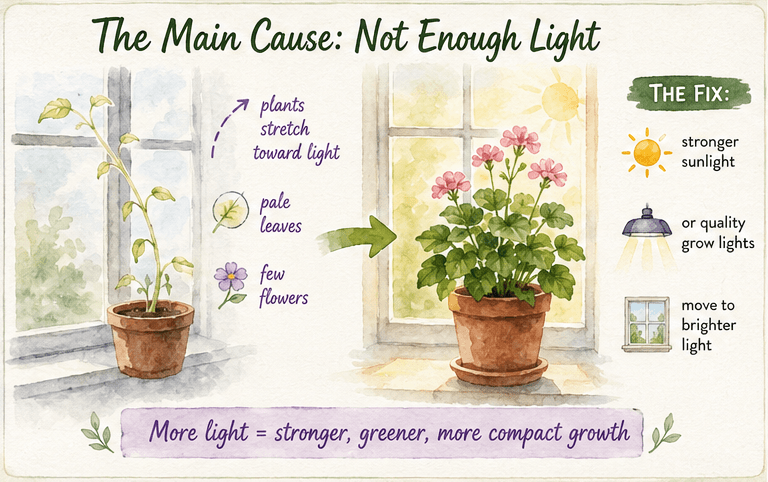
The Main Cause: Not Enough Light
Light is the most important factor behind tall and weak growth. Plants need light to make energy through photosynthesis. When light is too weak, the plant tries to reach toward stronger light.
This is called stretching or etiolation.
Indoors, this often happens when plants are placed near a window that looks bright to human eyes but is not strong enough for healthy plant growth. Human eyes adjust easily to low light, but plants need much stronger light than we often realize.
Signs Your Plant Needs More Light
Your plant may need more light if you notice:
- Stems leaning toward the window
- Long spaces between leaves
- Pale or weak-looking leaves
- Slow growth after stretching
- Few flowers or no flowers
- Seedlings falling over
- New growth smaller than older growth
- Plant growing upward but not becoming fuller
How to Fix Low Light
Move the plant to a brighter location. If growing indoors, place it near the brightest window available. For many plants, a south-facing window is best in the Northern Hemisphere. East-facing windows can work for gentler morning light, while west-facing windows provide stronger afternoon light.
If natural light is limited, use a grow light.
For seedlings and indoor plants, grow lights can make a major difference. They provide consistent light intensity and help plants grow shorter, stronger, and greener.
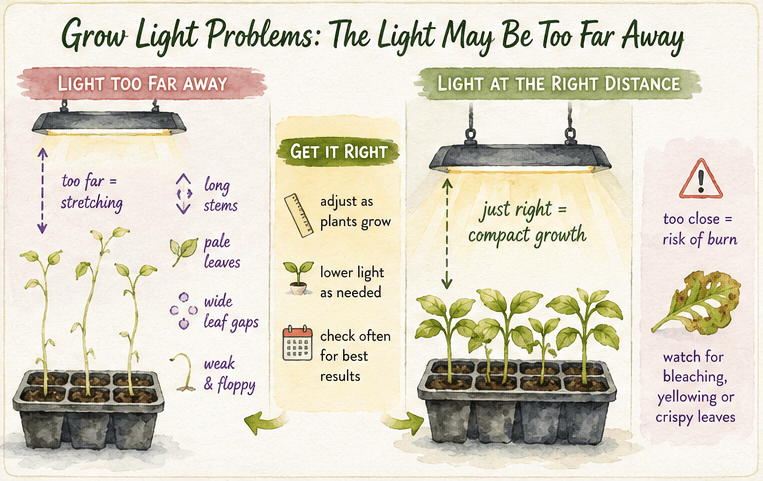
Grow Light Problems: The Light May Be Too Far Away
Even if you are using a grow light, your plants can still become tall and weak if the light is too far away or not strong enough.
Many beginners place grow lights too high above seedlings. When the light is too far away, plants stretch upward to reach it.
Signs Your Grow Light Is Too Far Away
You may notice:
- Seedlings leaning upward
- Thin stems
- Pale leaves
- Fast vertical growth
- Plants bending toward the strongest light
- Weak new growth
How Close Should Grow Lights Be?
The correct distance depends on the type and strength of the grow light. Many seedling grow lights work best when placed fairly close to the plants, often just a few inches above the leaves. Stronger lights may need more distance to avoid burning.
A good rule is to watch the plant response:
- If plants stretch, the light may be too far or too weak
- If leaves burn or curl, the light may be too close or too intense
- If growth is compact and green, the light is likely working well
Keep the light close enough to be effective and raise it gradually as plants grow.
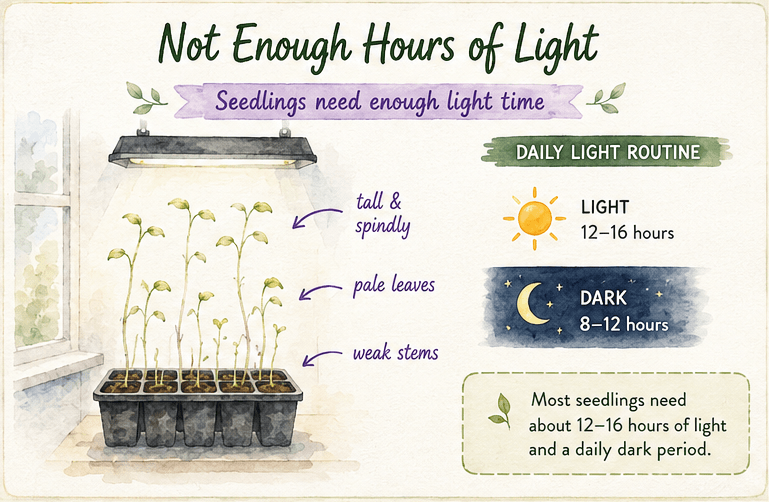
Not Enough Hours of Light
Sometimes the problem is not only light strength but also light duration.
Seedlings and many indoor plants need long periods of light to grow strong. A few hours of weak window light may not be enough.
Most seedlings grown indoors do best with around 12–16 hours of bright light per day. This helps them grow compact and sturdy.
How to Fix Light Duration
If using grow lights, keep them on for 12–16 hours per day. Do not leave them on 24 hours a day. Plants also benefit from a dark period.
A simple routine:
- 12–16 hours of light
- 8–12 hours of darkness
- Consistent schedule daily
Using a timer can help keep the lighting routine consistent.
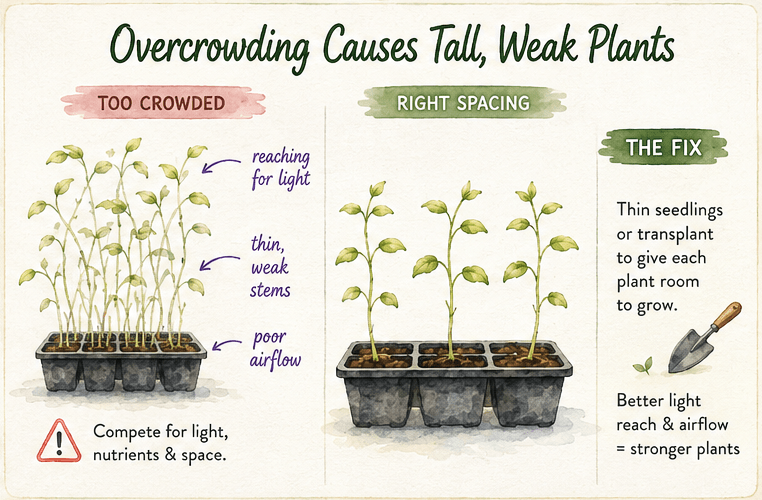
Overcrowding Causes Tall, Weak Plants
Overcrowding is another common cause of weak, stretched growth. When plants are too close together, they compete for light, space, airflow, water, and nutrients.
Seedlings growing in crowded trays often stretch upward because each plant is trying to rise above the others to reach light.
Signs Plants Are Overcrowded
You may notice:
- Thin stems
- Plants leaning into each other
- Leaves overlapping heavily
- Poor airflow
- Seedlings stretching upward
- Yellowing lower leaves
- Slow growth
- Increased disease problems
How to Fix Overcrowding
Thin seedlings early. Keep the strongest seedlings and remove weaker ones so each plant has enough room.
If seedlings are large enough, transplant them into individual pots.
Proper spacing helps plants grow stronger stems, healthier roots, and better leaf development.
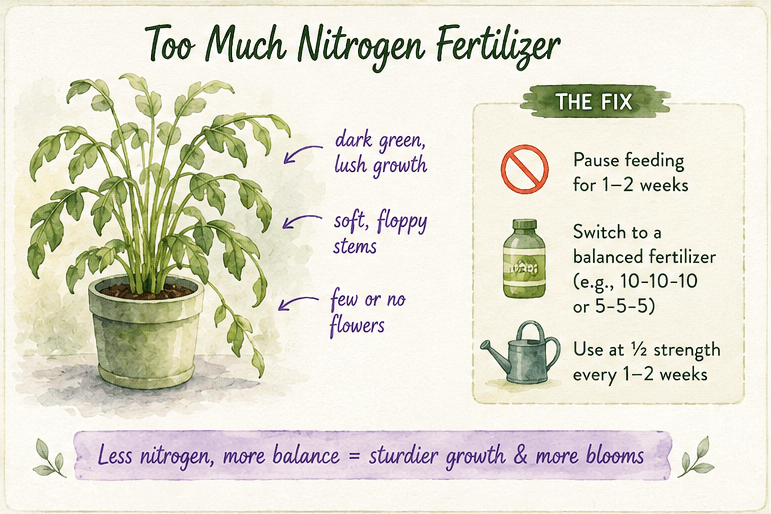
Too Much Nitrogen Fertilizer
Fertilizer helps plants grow, but too much nitrogen can cause soft, leafy, weak growth. Nitrogen encourages leaf and stem growth. When used excessively, it may make plants grow quickly but not strongly.
This can lead to tall, lush-looking plants with weak stems and fewer flowers.
Signs of Too Much Nitrogen
Possible signs include:
- Lots of leafy growth
- Soft green stems
- Weak structure
- Few flowers
- Delayed blooming
- Plants growing fast but floppy
- Dark green leaves with poor strength
How to Fix Too Much Nitrogen
Stop fertilizing temporarily. Allow the plant to use up excess nutrients.
When feeding again, use a balanced fertilizer and avoid overfeeding. For flowering plants, avoid using too much high-nitrogen fertilizer once the plant is mature enough to bloom.
For seedlings, always use diluted fertilizer. Strong feeding is rarely necessary early on.
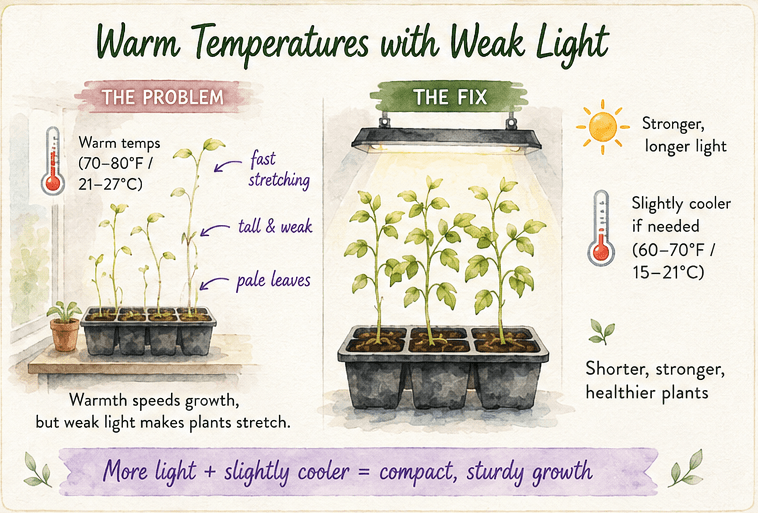
Warm Temperatures with Weak Light
Warmth encourages plants to grow. But when temperatures are warm and light is weak, plants often stretch quickly.
This is very common indoors. A warm room tells the plant to grow, but weak light does not provide enough energy for strong development. The result is tall, thin, weak growth.
Signs This Is Happening
You may notice:
- Seedlings growing too fast and too tall
- Thin stems
- Pale leaves
- Plants leaning toward light
- Weak growth during winter indoors
- Fast stretching after germination
How to Fix It
Increase light first. If you cannot increase light enough, slightly cooler growing conditions may help slow stretching.
For seedlings, provide strong light immediately after germination. Do not wait until they are already tall.
Warmth is helpful for germination, but after sprouting, seedlings need light right away.
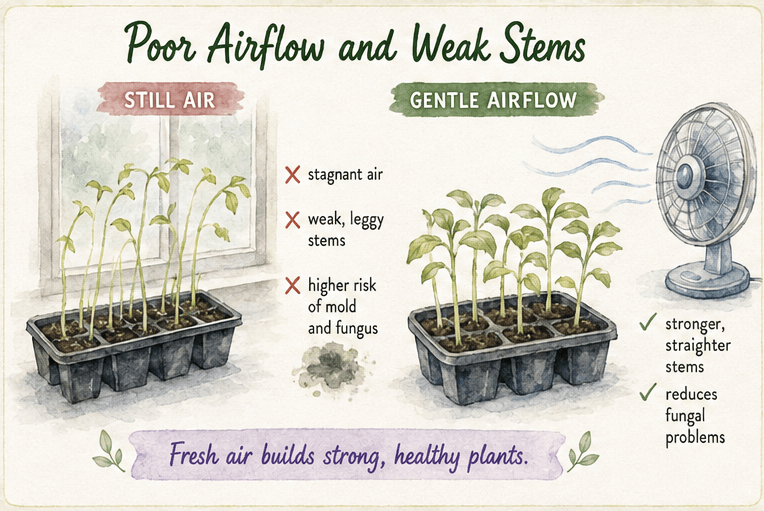
Poor Airflow and Weak Stems
Plants grown indoors without airflow often develop weaker stems. Outdoors, natural wind gently moves plants, encouraging stronger stem development. Indoors, still air can make plants softer and weaker.
Poor airflow can also increase disease risk, especially when combined with moist soil and crowded seedlings.
Signs of Poor Airflow
You may notice:
- Weak stems
- Seedlings falling over
- Mold on soil surface
- Slow drying soil
- Fungal issues
- Crowded, damp trays
How to Improve Airflow
Use a small fan on a gentle setting. The goal is not to blast the plants with strong wind. You only want gentle movement.
Good airflow helps:
- Strengthen stems
- Reduce fungal problems
- Dry soil more evenly
- Improve overall plant health
For seedlings, gentle airflow can make a noticeable difference.
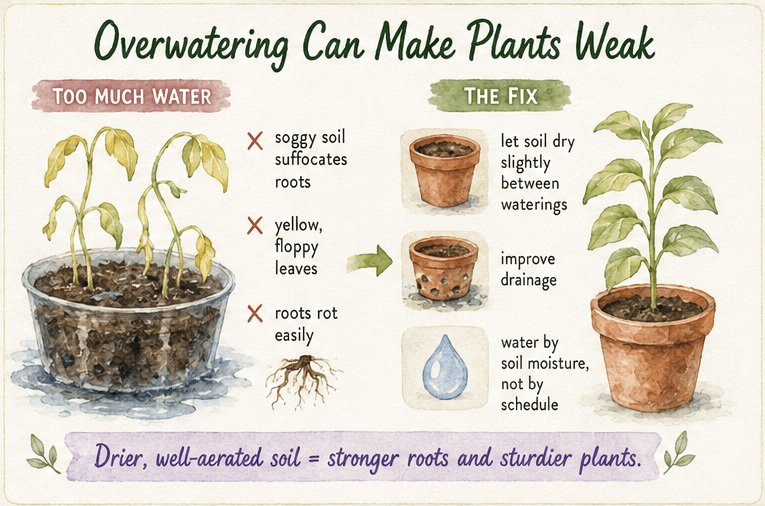
Overwatering Can Make Plants Weak
Overwatering does not usually cause stretching by itself, but it can make plants weak. Wet soil reduces oxygen around the roots. Weak roots lead to weak top growth.
If a plant is both overwatered and lacking light, it may become yellow, floppy, and stretched.
Signs of Overwatered Weak Plants
Look for:
- Wet soil that stays wet too long
- Yellow leaves
- Drooping despite wet soil
- Soft stems
- Mold on soil
- Slow growth
- Weak root system
How to Fix Overwatering
Let the soil dry slightly before watering again. Make sure containers have drainage holes.
Use a lighter, better-draining potting mix if the soil is dense. Improve airflow and light so the soil dries properly.
Water based on soil moisture, not a fixed schedule.
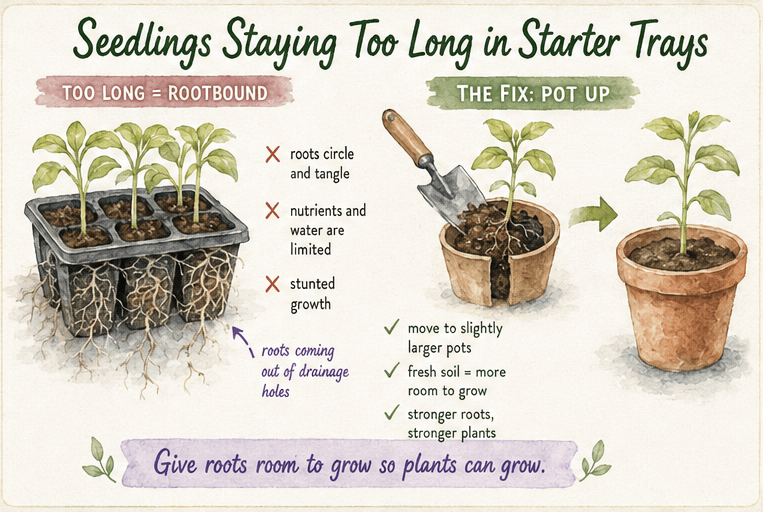
Seedlings Staying Too Long in Starter Trays
Seedlings can become tall and weak if they stay too long in small cells. Once roots fill the space, the plant may struggle to absorb water and nutrients properly.
Crowded roots can slow growth and weaken the plant.
Signs Seedlings Need Transplanting
Seedlings may need a larger pot if:
- Roots are coming out of drainage holes
- Growth has slowed
- Plants dry out very quickly
- Leaves are yellowing
- Stems are weak
- Seedlings have several true leaves
- Roots are circling inside the cell
How to Fix It
Transplant seedlings into slightly larger pots with fresh potting mix. Do not move tiny seedlings into oversized pots. A pot that is too large may hold too much moisture.
After transplanting, provide bright light and gentle watering while the seedlings adjust.
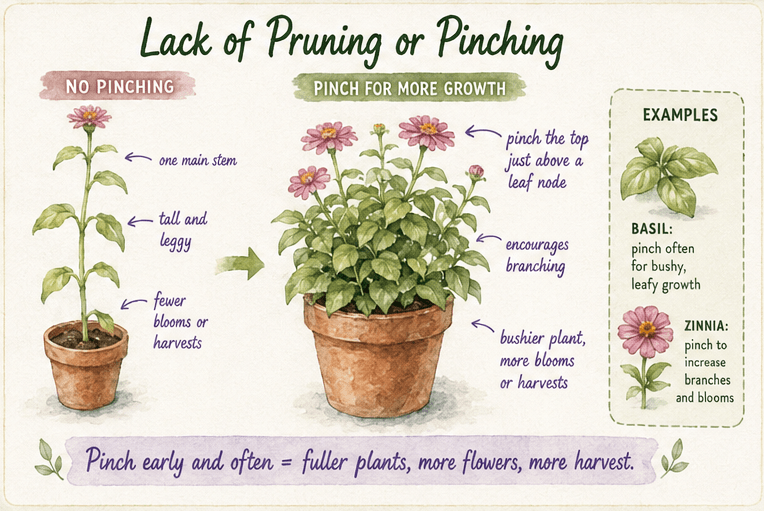
Lack of Pruning or Pinching
Some plants naturally need pruning or pinching to grow fuller. Without pruning, they may grow upward as a single tall stem instead of branching.
This is especially common with many herbs, flowers, and ornamental plants.
Plants That Often Benefit from Pinching
Many plants can become fuller with pinching, including:
- Basil
- Mint
- Zinnia
- Cosmos
- Marigold
- Coleus
- Snapdragon
- Some flowering annuals
How Pinching Helps
Pinching removes the growing tip, encouraging side branches to develop. This creates a bushier plant instead of one tall stem.
Pinching should usually be done when the plant is healthy and has enough leaves to recover. Avoid pinching very weak or tiny seedlings too early.
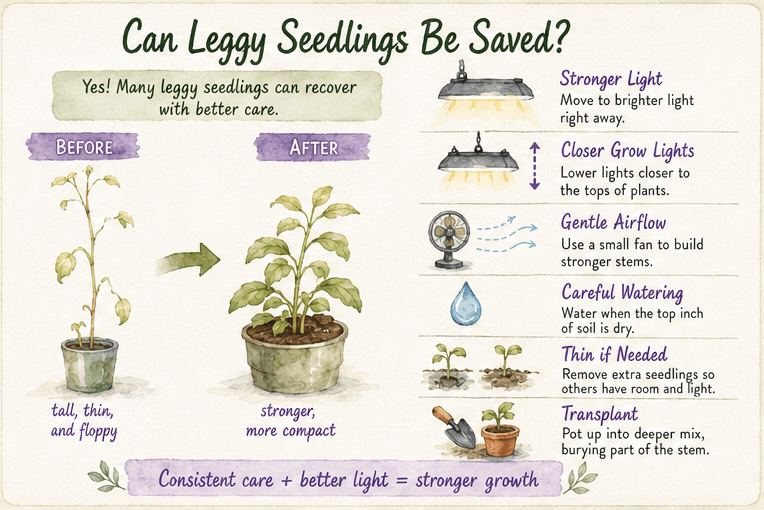
Can Leggy Seedlings Be Saved?
Yes, many leggy seedlings can be saved if they are not too weak or diseased.
The first step is to improve the growing conditions immediately.
How to Save Leggy Seedlings
To help leggy seedlings recover:
- Move them to stronger light
- Place grow lights closer
- Provide 12–16 hours of light daily
- Improve airflow
- Thin overcrowded seedlings
- Transplant if roots need more space
- Water carefully
- Avoid overfertilizing
Some seedlings can be transplanted slightly deeper to support the stem. Tomatoes are a good example because they can grow roots along buried stems. However, not all plants like being buried deeply, so be careful.
If a seedling is extremely thin, pale, and falling over, it may not recover well. In that case, restarting with better light may be faster.
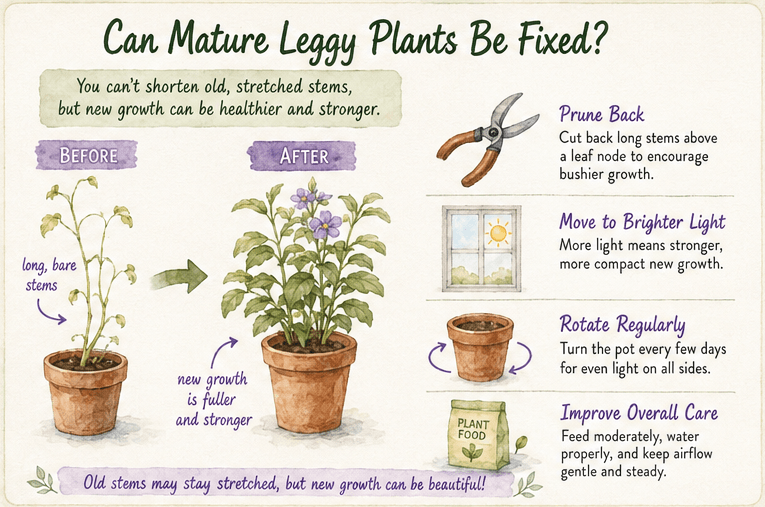
Can Mature Leggy Plants Be Fixed?
Mature leggy plants can often be improved, but they may not instantly return to a compact shape.
The best approach depends on the plant type.
How to Fix Mature Leggy Plants
You can often improve mature leggy plants by:
- Moving them to brighter light
- Pruning back long weak stems
- Rotating the pot regularly
- Feeding properly, not excessively
- Improving airflow
- Repotting if roots are crowded
- Providing support if needed
New growth after the correction should be stronger. Old stretched stems may remain thin, but pruning can help reshape the plant over time.
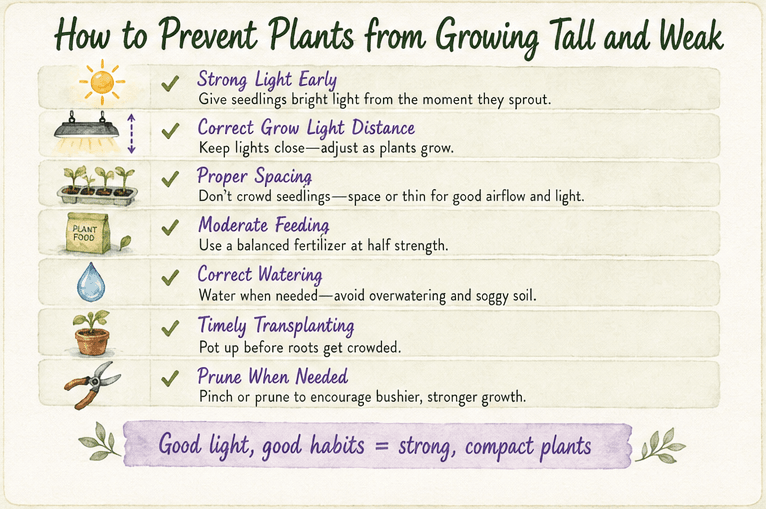
How to Prevent Plants from Growing Tall and Weak
Prevention is easier than fixing leggy growth.
To prevent tall and weak plants:
- Provide strong light early
- Use grow lights for indoor seedlings
- Keep grow lights close enough
- Give seedlings 12–16 hours of light daily
- Thin crowded seedlings
- Improve airflow
- Avoid too much nitrogen
- Water correctly
- Transplant seedlings on time
- Pinch or prune plants that need branching
- Rotate indoor plants regularly
The most important rule is:
Give plants enough light before they start stretching.
Once stretching begins, plants can improve, but prevention gives much better results.
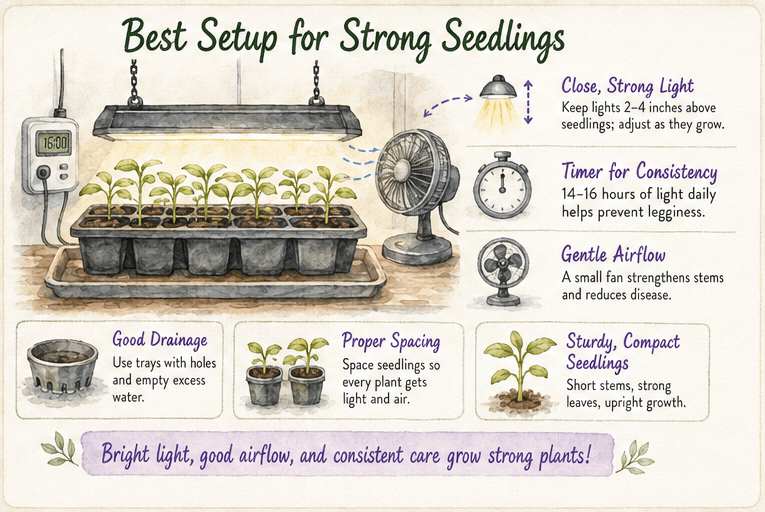
Best Setup for Strong Seedlings
If you are growing from seeds, the right setup helps prevent weak growth from the beginning.
A strong seedling setup includes:
- Fresh seed-starting mix
- Clean containers with drainage holes
- Bright grow light
- 12–16 hours of light daily
- Light placed close enough to seedlings
- Gentle airflow from a small fan
- Careful watering
- Proper spacing
- Transplanting when seedlings outgrow cells
This setup helps seedlings grow short, green, sturdy, and ready for transplanting.
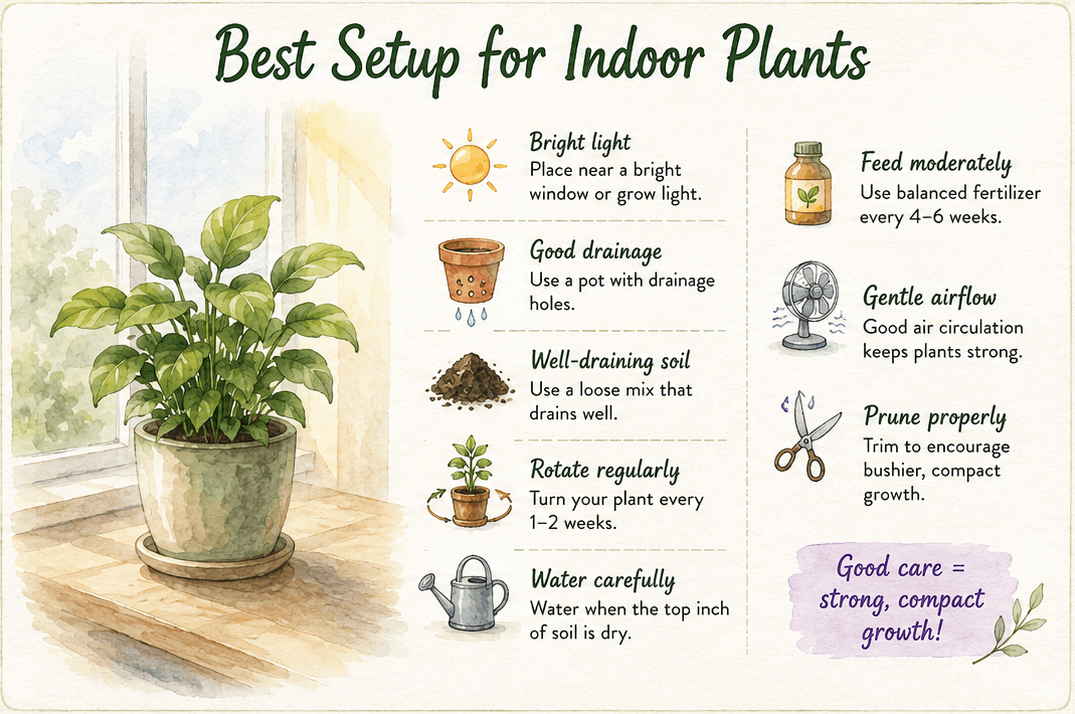
Best Setup for Indoor Plants
Indoor plants also need enough light and airflow to avoid weak growth.
A good indoor setup includes:
- Bright window or grow light
- Pot with drainage holes
- Well-draining soil
- Regular pot rotation
- Careful watering
- Moderate feeding
- Gentle airflow
- Proper pruning when needed
If your indoor plant always leans toward the window, rotate the pot every few days and consider increasing light.
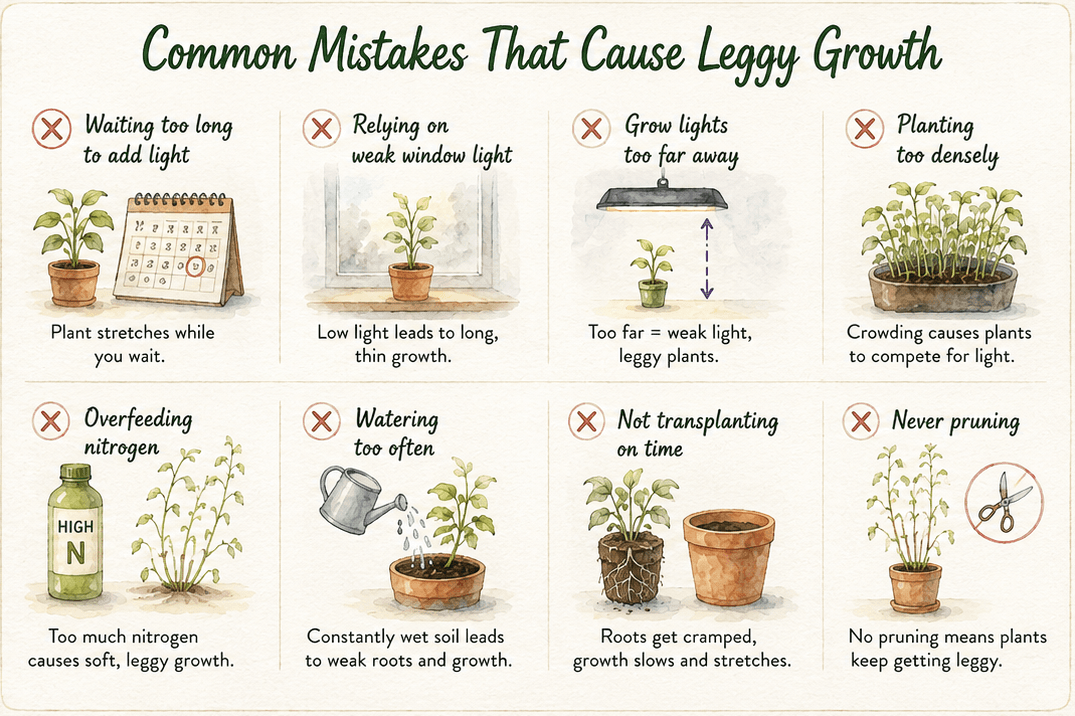
Common Mistakes That Cause Leggy Growth
Waiting Too Long to Add Light
Seedlings need strong light immediately after germination.
Relying on Weak Window Light
A bright window may still not be enough for many seedlings.
Keeping Grow Lights Too Far Away
If lights are too far, plants stretch toward them.
Planting Too Many Seeds Too Close Together
Crowded seedlings compete for light and become weak.
Overfeeding with Nitrogen
Too much nitrogen can cause soft, floppy growth.
Watering Too Often
Wet soil weakens roots and contributes to poor structure.
Not Transplanting on Time
Rootbound seedlings may become weak and stressed.
Never Pruning
Some plants need pinching or pruning to become bushy.
Leggy Plant FAQ
Why are my seedlings growing tall and thin?
Seedlings usually grow tall and thin because they are not getting enough light. Move them to stronger light or use a grow light.
Can leggy seedlings recover?
Yes, many can recover if given stronger light, better airflow, and proper care. Very weak seedlings may be better restarted.
Should I bury leggy seedlings deeper?
Some seedlings, like tomatoes, can be buried deeper because they form roots along the stem. Other plants may not tolerate deep planting, so check the plant type first.
Why are my indoor plants leaning toward the window?
They are reaching for stronger light. Rotate the pot and move the plant to a brighter location if possible.
Do plants get leggy from too much fertilizer?
Yes, too much nitrogen fertilizer can cause fast, soft, weak growth.
How close should grow lights be to seedlings?
It depends on the light strength. If seedlings stretch, the light is likely too far or too weak. Keep lights close enough for compact growth without burning leaves.
Does airflow help seedlings grow stronger?
Yes. Gentle airflow helps strengthen stems and reduce disease problems.
Why are my plants tall but not flowering?
They may not be getting enough light, or they may be receiving too much nitrogen fertilizer. Flowering plants need strong light and balanced feeding.
Can pruning fix leggy plants?
Pruning can help encourage branching and improve shape, especially when combined with better light.
How do I stop plants from growing weak?
Provide strong light, proper spacing, good airflow, correct watering, and avoid overfeeding with nitrogen.
Final Thoughts: Strong Light Builds Strong Plants
Tall and weak plant growth is usually a sign that the plant is trying to reach better conditions. Most often, the missing factor is light.
When plants do not receive enough light, they stretch. When they stretch too much, stems become thin, leaves become spaced far apart, and the plant becomes weaker overall.
The best solution is to act early.
Give more light.
Move grow lights closer.
Thin crowded seedlings.
Improve airflow.
Water correctly.
Avoid too much nitrogen.
Transplant when needed.
Prune or pinch plants that need branching.
Once your plants receive the right conditions, new growth can become stronger, greener, and more compact. With better light and balanced care, tall weak plants can often recover and grow into healthy, productive plants.

Start Your Desert Rose Journey from Seeds
Growing Desert Rose from seeds is one of the most rewarding ways to enjoy Adenium. Explore our selected Desert Rose seeds and start growing your own unique plants with beautiful shapes, vibrant blooms, and natural caudex development.
Recommended Desert Rose SeedsShop All


 1
1 Mixed
Mixed
 1Mixed
 1Mixed
 1Mixed
 1Mixed
 1Mixed
 1Mixed
 1Mixed
 1Mixed
 1Mixed
 1Mixed
 1Mixed
 1Mixed
 1Mixed
 1Mixed
 1Mixed
 1Mixed
 1Mixed
 1Mixed
 1Mixed
 1Mixed
 1Mixed
 1Mixed
 1Mixed
 1Mixed
 1Mixed
 1Mixed
 1Mixed
 1Mixed
 1
1Adenium Obesum Desert Rose Seeds – Yellow Siam Flower Bonsai Seeds for Garden Planting, 5 Seeds Pack

 1Mixed
 1Mixed
 1Mixed
 1Mixed
 1Mixed
 1Mixed
